


Climate Ready DC Resilient Design Guidelines
The Climate Ready DC (CRDC) Resilient Design Guidelines were developed by the DC Department of Energy and Environment (DOEE) in 2021 to provide a methodology for assessing infrastructure vulnerabilities and best practices for reducing climate risks. Incorporating resilience early in the design of infrastructure projects reduces risks for residents and can save money by preventing damage caused by extreme weather events. Intended for use by municipal planning and regulatory staff, building owners, developers, facility managers, agencies, engineers, and architects, the Guidelines provide a strategic framework for project teams to identify climate vulnerabilities and to incorporate resilient strategies into their building and landscape infrastructure designs.
The Guidelines are broken down into four sections: (1) Introduction and Context, (2) Understanding Vulnerabilities in the District, (3) Applying Resilience in the District, and (4) Resilient Design Strategies. Section 1 provides context on the need for resilience in the District, while Section 2 elaborates on the two most prominent vulnerabilities in the District: flooding and extreme heat. DC currently experiences riverine, interior, and coastal flooding, all of which will be impacted in the future by sea level rise and extreme precipitation. Average temperatures are expected to rise, especially in denser urban areas, due to the Urban Heat Island (UHI) effect. The Guidelines explains these vulnerabilities, outlines future projections, and discusses how these projections will impact both human health and infrastructure throughout the District. Building off of Section 2, Section 3 explains the importance of defining vulnerabilities when planning for resilient infrastructure and outlines the steps to developing a Resilience Profile for a project. Steps include:
- Defining Criticality;
- Defining Life Expectancy;
- Defining Climate Risks by Location; and,
- Prioritizing Resilience Strategies.
Current building and infrastructure codes do not account for the vulnerability risks the District may face as the climate continues to change. To help project teams incorporate climate resilience into existing and future infrastructure projects, Section 4 of the Guidelines provides 64 specific resilient design strategies organized into two categories: Building Strategies and Site and Landscape Strategies. The strategies each fall under one of four design consideration themes—flooding, extreme heat, power outages, and waterfront considerations—and each includes:
- Applicability and cost considerations;
- Operations and maintenance impacts;
- Related resources and regulations;
- Assessment and implementation guidance; and,
- Project benefits.
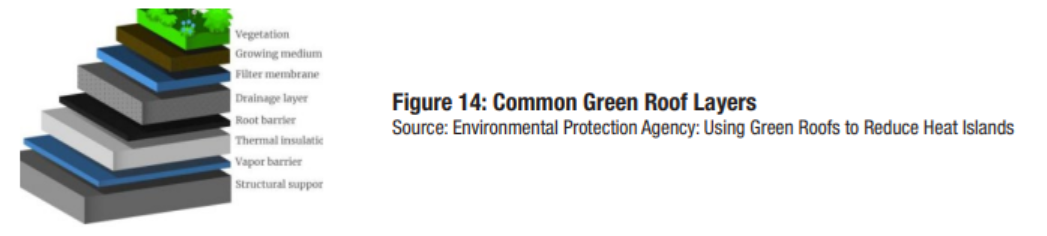
For example, Buildings Strategy #11, “Consider a Vegetative (Green) Roof”, explains how green roofs capture and retain stormwater during rain events and can reduce the Urban Heat Island effect. This strategy provides recommendations for vegetative roof installation, identifies which roofs are structurally fit for the intervention, and explains that significant ongoing maintenance will be required to keep plantings healthy.
These guidelines were created as part of the implementation of the District’s Climate Ready DC Plan, the District’s plan to meet the demands of higher temperatures, more intense precipitation, and increased flooding resulting from climate change. Climate Ready DC aims to improve community preparedness through a variety of adaptation initiatives and tools, including flood risk reduction tools, community resilience hubs, and the Resilience and Solar Assessment Tool.
Publication Date: 2021
Related Resources:
- DC Flood Task Force Final Report (2023)
- Climate Ready DC: The District of Columbia’s Plan to Adapt to a Changing Climate
Sectors:
Resource Category:
Resource Types:
- Assessment guide
- Best practice
States Affected:
Impacts:
- Coastal Flooding
- Flooding
- Heat waves
- Precipitation changes
- Riverine Flooding
