All Adaptation Equity Resources
This tab includes all adaptation equity resources in the Adaptation Clearinghouse. Apply filters to view resources for a particular region or state, or search by sector. You may also sort by source of disproportionate risk.
Resources are automatically presented by date, but can also be sorted by network rating and title.
551 results are shown below.
Filter by States AffectedSelect states to filter this list
All
Alabama Alaska American Samoa Arizona Arkansas California Colorado Connecticut Delaware District of Columbia Florida Georgia Guam Hawaii Idaho Illinois Indiana Iowa Kansas Kentucky Louisiana Maine Maryland Massachusetts Michigan Minnesota Mississippi Missouri Montana Nebraska Nevada New Hampshire New Jersey New Mexico New York North Carolina North Dakota Northern Marianas Islands Ohio Oklahoma Oregon Pennsylvania Puerto Rico Rhode Island South Carolina South Dakota Tennessee Texas Utah Vermont Virgin Islands Virginia Washington West Virginia Wisconsin Wyoming
Resource
September 28, 2015
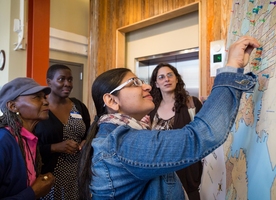
Cleveland Neighborhood Progress, in partnership with the University of Buffalo and the Cleveland Office of Sustainability, initiated a project in 2015 to improve climate resilience in Cleveland neighborhoods. The project seeks to take an asset-based approach to adaptation planning, building upon existing partnerships, programs, the work of community organizations and residents, and a large inventory of vacant land. With support from the Kresge Foundation, a team of trained Climate Ambassadors began work in four neighborhoods to recruit participants for community workshops and to identify projects, programs, policies, and future research.
Resource Category: Planning
See Resource Login to Add to My Resource List
Resource
Louisiana's Coastal Protection and Restoration Authority (CPRA) has launched a “Flood Risk and Resilience Viewer,” an online resource which displays information on coastal land change, flood risk, and impacts to communities. This innovative tool provides coastal residents with access to the state’s best information about how Louisiana’s coast may change in the future, as well as resources to make communities and properties safer.
Resource Category: Data and tools
See Resource Login to Add to My Resource List
Resource
September 2015
The Natural Resources Defense Council (NRDC) has developed an online interactive map of ocean acidification implications on coastal communities. The mapping approach determines where the ocean chemistry is changing most rapidly, where vulnerable species are located, and where people who most depend on these species reside. The intersection of these factors reveals an elevated risk from ocean acidification.
Resource Category: Data and tools
See Resource Login to Add to My Resource List
Resource
August 26, 2015
The South Ironbound Resiliency Action Plan lays out resiliency goals for a portion of the Ironbound neighborhood in the East Ward of Newark, New Jersey called South Ironbound, that will inform funding priorities and inform longer term climate mitigation and adaptation goals. The neighborhood is prone to flooding due to sewer back-ups, heavy rain storms, and storm surge. The report is organized into strategic components related to resilience. For each strategy, there is an in-depth review of major actions and implementation considerations.
Resource Category: Planning
See Resource Login to Add to My Resource List
Resource
August 19. 2015
This report describes how climate-related extreme weather events exacerbate existing socioeconomic inequalities. In this case, the report highlights the disproportionate challenges experienced by frontline communities during the California drought that began in 2012, which includes communities of color and low-income people living in tribal, rural, and farming communities. The report discusses the following topics: the causes and severity of California’s drought; the drought’s impacts on the national food system; demographics, water rights, and drought impacts in agricultural communities; and policy recommendations.
Author or Affiliated User: Wendy Ortiz
Resource Category: Solutions
See Resource Login to Add to My Resource List
Resource
August 18, 2015
This issue brief by the Center for American Progress discusses how climate change and extreme weather events are contributing to an increase in the displacement of Americans from their homes and communities. The article reviews the impacts of Hurricane Katrina in 2005 including the effects of displacement of 1. 5 million people in the region; and describes the thousands more people that have been displaced by other extreme weather disasters. The analysis recommends several steps that policymakers can take to find and assist climate-displaced people, highlighting the compounded impacts on vulnerable populations.
Author or Affiliated User: Danielle Baussan
Resource Category: Assessments
See Resource Login to Add to My Resource List
Resource
August 2015
This interactive website provides a series of maps depicting the vulnerability of each county in the U.S. to heat as a result of climate change. Drawing on global climate models and socioeconomic metrics, these maps allow for county-level analysis of heat risk and can be used to bolster community engagement and preparedness planning.
Resource Category: Data and tools
See Resource Login to Add to My Resource List
Resource
August 2015
This case study discusses how Washington DC is preparing for the impacts of climate change including sea-level rise, increasing flood risks, and heat waves. The case study explores how District agencies integrated considerations of climate change when developing the city's Sustainable DC plan, which was developed through an interagency working group. This effort spurred the development of a city-wide vulnerability assessment and adaptation plan. The case study also explores the District’s efforts to reduce urban heat islands by making grants to pilot the use of cool roofs, implementing the Smart Roof Initiative to retrofit District-owned buildings, and adopting of a new Green Building Code.
Author or Affiliated User: Sara Hoverter
Resource Category: Solutions
See Resource Login to Add to My Resource List
Resource
August 2015
The Community-Driven Climate Resilience Planning framework was developed to help community-based organizations define and build climate resilience, while meaningfully engaging vulnerable and impacted communities. The framework advocates advancing democratic practices at the local and regional levels, describes the principles and practices defining this emergent field, and offers resources for community-based institutions implementing community-driven planning processes. A new version of this resource has been published.
Author or Affiliated User: Rosa González
Resource Category: Planning
See Resource Login to Add to My Resource List
Resource
July 27, 2015
The Northern Manhattan Climate Action Plan (NMCA) was built by and for the residents of Northern Manhattan of New York City, New York in partnership with WE ACT for Environmental Justice. The plan addresses climate-related impacts on New York City’s most vulnerable populations by promoting environmental policies that also aim to address socioeconomic inequality. The NMCA recognizes “that issues of class, race, gender, ethnicity, and age, not simply rising sea levels and temperatures, must be mitigated and ultimately overcome.
Author or Affiliated User: Aurash Khawarzad
Resource Category: Planning
See Resource Login to Add to My Resource List