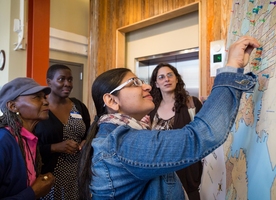
Communication, Community Participation, and Outreach
This tab provides information on how to work with frontline communities, the public and other stakeholders to understand and address climate vulnerabilities.
Resources are automatically presented by date. Apply additional filters to narrow the list by organization type of author, state, jurisdictional focus, region, or resource type.
85 results are shown below.
Filter by States AffectedSelect states to filter this list
All
Alabama Alaska American Samoa Arizona Arkansas California Colorado Connecticut Delaware District of Columbia Florida Georgia Guam Hawaii Idaho Illinois Indiana Iowa Kansas Kentucky Louisiana Maine Maryland Massachusetts Michigan Minnesota Mississippi Missouri Montana Nebraska Nevada New Hampshire New Jersey New Mexico New York North Carolina North Dakota Northern Marianas Islands Ohio Oklahoma Oregon Pennsylvania Puerto Rico Rhode Island South Carolina South Dakota Tennessee Texas Utah Vermont Virgin Islands Virginia Washington West Virginia Wisconsin Wyoming
Resource
February 6, 2024
The Community Change Grant Equitable Resilience technical assistance program, an initiative spearheaded by the U.S. the Environmental Protection Agency, will provide free assistance to entities applying for Community Change Grants. EPA plans to offer this technical assistance to up to 50 Community Change Grants applicants. The program will provide free project development assistance, community engagement, and partnership development workshops.
Related Organizations: U.S. Environmental Protection Agency (EPA)
Resource Category: Data and tools
See Resource Login to Add to My Resource List
Resource
May 4, 2023
Washington House Bill 1176, passed May 4, 2023, creates the Washington Climate Corps Network. In recognizing that climate change presents adaptation and resilience difficulties to Washington, HB 1176 looks to mobilize young adults and “create a clean energy economy. ” The Washington Climate Corps Network will emphasize “equity-centered, climate-related service programs. ” There is an additional emphasis on recruiting volunteers from “overburdened and underserved communities” to serve as volunteers.
Related Organizations: Serve Washington
Resource Category: Law and Governance
See Resource Login to Add to My Resource List
Resource
June 16, 2022
The City of North Miami, Florida Good Neighbor Stormwater Park is a public open space with the capacity for local flood prevention, doubling as a stormwater reservoir. A repurposed vacant lot within North Miami’s residential neighborhood of Sunny Acres, this adaptive stormwater green infrastructure is vegetated with an array of native trees and plants, while also acting as a communal space with walking paths and artistic structures that educate the public on flooding hazards. The project was funded in part through the Van Alen Institute’s Keeping Current: Repetitive Loss Properties Grant design competition, won by the City of North Miami, and the landscape architecture firm Dept. for implementation. The Stormwater Park was once considered a repetitive loss property by the Federal Emergency Management Agency (FEMA), due to repetitive flooding from stormwater and sea-level rise — common across South Florida neighborhoods. As a part of the project, the landscape architects selected to design the park were also asked to put together a plan that could support the replication of this pilot project across the region in the most flood vulnerable communities. Dept. developed a Repetitive Loss Master Plan, which illustrates priority strategies for flood risk reduction and resilient design. Other local decisionmakers of flood-prone communities with vacant, abandoned, deteriorated, or repetitive loss lots can look to North Miami’s example for green infrastructure public space design planning that goes beyond capturing stormwater, and integrates the community’s well-being — such as access to green space — for greater long-term resilience. This case study is one of 24 case studies featured in a report written by the Georgetown Climate Center, Greauxing Resilience at Home: A Collection of Lessons and Case Studies from Louisiana and Beyond
Related Organizations: Georgetown Climate Center
Resource Category: Solutions
See Resource Login to Add to My Resource List
Resource
June 16, 2022
The Imagine Plank Road: Plan for Equitable Development (plan) is an equitable transit-oriented development (TOD) plan developed to guide revitalization of the Plank Road corridor, an area in north Baton Rouge and East Baton Rouge Parish (parish). Released in November 2019, the plan is a response to historical disinvestment in the Plank Road corridor and addresses issues of infrastructure decay, jobs and commerce, and health and safety. The plan is anchored by a new bus rapid transit (BRT) system that will run along the corridor and connect it to other parts of Baton Rouge. There are seven new developments proposed along the corridor, each designed to provide quality of life amenities and generate tax revenue while preserving local neighborhoods’ history and culture. The Plank Road plan is notable for its goals, metrics, and recommendations for equity-focused community revitalization. At the project level, local policymakers can look to the plan for specific efforts related to urban affordable housing, community-driven development, green infrastructure, and community engagement. More broadly, the plan demonstrates how policymakers can integrate equity across various development initiatives in order to lay a foundation for long-term stability and growth. Build Baton Rouge (BBR) is the lead agency on the plan and took an approach that emphasized community engagement and public-private partnerships in planning and implementation. The Plank Road plan will be implemented concurrently with FUTUREBR, the comprehensive master plan adopted by the parish and the City of Baton Rouge in 2011. This case study is one of 24 case studies featured in a report written by the Georgetown Climate Center, Greauxing Resilience at Home: A Collection of Lessons and Case Studies from Louisiana and Beyond
Related Organizations: Georgetown Climate Center
Resource Category: Solutions
See Resource Login to Add to My Resource List
Resource
June 16, 2022
The Ardendale Master Plan and Guiding Principles (plan) is a planned community development in the Ardenwood area of Baton Rouge, Louisiana. Ardendale consists of 200 acres purchased in 2012 by Build Baton Rouge (BBR), the city’s redevelopment agency. The site currently includes public housing, the automotive technology campus of Baton Rouge Community College, and several acres of wetlands. As proposed under the plan, Ardendale will become a new urbanist community that will include the following types of planned projects: mixed-income affordable housing, infrastructure, quality-of-life amenities, and cohesive landscaping. Specifically, the new vision for Ardendale is to build amenities like housing, businesses, and green space and integrate public access across various community resources to grow socioeconomic resilience. As part of this vision, the plan also includes landscaping design rules that aim to encourage outdoor recreation and community gathering, mitigate natural hazards, and enhance neighborhood aesthetics and culture by using native plants. By balancing community needs and character, the plan demonstrates a multi-faceted and integrated approach to redevelopment that may be illustrative for local policymakers preparing for population growth due to climate change. This case study is one of 24 case studies featured in a report written by the Georgetown Climate Center, Greauxing Resilience at Home: A Collection of Lessons and Case Studies from Louisiana and Beyond
Related Organizations: Georgetown Climate Center
Resource Category: Solutions
See Resource Login to Add to My Resource List
Resource
In 2021, the Climigration Network, in partnership with a diverse team of researchers, released Lead with Listening: A Guidebook for Community Conversations on Climate Migration. The guidebook is a resource on climate migration and how to have effective dialogue about it. It addresses how various factors (e. g. , cultural, financial, and location) make conversations surrounding the topic of climate migration (also called “managed retreat” or “relocation,” among other terms) challenging.
Related Organizations: The Climigration Network
Resource Category: Education and Outreach
See Resource Login to Add to My Resource List
Resource
California’s Community Assistance for Climate Equity Program (CACE) provides capacity-building support to the state’s most under-resourced communities enabling them to build community driven leadership, partnerships, and grant writing knowledge and skills. Specifically, CACE provides assistance to these communities to help them obtain state funding from the California Climate Investments (CCI) program to plan and implement projects on climate change mitigation, adaptation, and resiliency.
Related Organizations: California Strategic Growth Council
Resource Category: Education and Outreach
See Resource Login to Add to My Resource List
Resource
October 2020
This guide from Clean Energy Group (CEG) answers twelve of the most common questions surrounding solar+storage. Topics include the cost and value of a solar+storage system, the benefits of the system, and common factors to consider when designing and installing such a system. By addressing these questions, this guide aims to serve as a starting point for individuals and organizations interested in exploring solar+storage for their homes, businesses, and community facilities. The guide was produced under the Resilient Power Project, a joint project of CEG and the Meridian Institute, which work to accelerate the market development of resilient, clean energy solutions in low-income and underserved communities.
Related Organizations: Clean Energy Group
Resource Category: Education and Outreach
See Resource Login to Add to My Resource List
Resource
October 2020
The Greening in Place guide serves to assist public agencies and developers in pursuing equitable green development and combating the displacement impacts that green investments can invoke. It includes an assessment of the displacement risks associated with green investment, a framework for equitable green development, several case studies, and a range of policies and strategies that can be used in partnership with the affected communities. By pursuing these strategies, park agencies and community advocates can advance racial and economic equity and promote healthy, sustainable, and inclusive green development.
Resource Category: Data and tools
See Resource Login to Add to My Resource List
Resource
October 2020
The Michigan Department of Health and Human Services, in collaboration with Michigan State’s School of Planning, Design and Construction, released their Climate and Health Adaptation Planning Guide for Michigan Communities in October 2020. The purpose of the Guide is to help communities in Michigan and other Great Lakes states develop a climate and health adaptation plan and integrate climate and health concepts into existing initiatives. The Guide describes a step-by-step approach laying out how communities can develop a plan, and includes tools and guidance on how to implement each step.
Related Organizations: Michigan Department of Health and Human Services, Michigan State University
Resource Category: Planning
See Resource Login to Add to My Resource List