


A Roadmap for Climate Resilience in Sonoma County, California
This plan provides a framework and recommendations for how Sonoma County, California should approach climate resilience. It emphasizes the importance of establishing a strong decision-making process which incorporates climate concerns into decisions at every level of the community. In addition to outlining adaptation goals, the Sonoma County plan also organizes its recommended actions by what type of actor is best placed to achieve them. The plan covers five categories of actors: individuals and households, businesses, government, working land managers, and civil society. It argues that the entire community must take a role in climate adaptation, asserting that, “[w]e will know we have succeeded in creating a climate resilient Sonoma County when the easiest, cheapest, most normal thing to do in any situation is also the most climate resilient thing to do.”
An eight-step framework for adaptation decision-making is presented in the plan’s “The Process Matters” section. These steps include:
- Define a vision for a climate resilient Sonoma County
- Define the system
- Assess vulnerabilities: climate impacts, adaptive capacity, timing, uncertainties
- Prioritize adaptive needs
- Identify strategies. Estimate their efficacy, timing, cost, co-benefits, and feasibility
- Prioritize strategies
- Implement in phases. Create accountability
- Monitor implementation, monitor resilience indicators, evaluate, adapt plan
The plan also outlines nine climate resilience goals that are designed to address extreme heat, drought, wildfires, fewer freezing nights, extreme floods, higher sea level, and high storm surges.
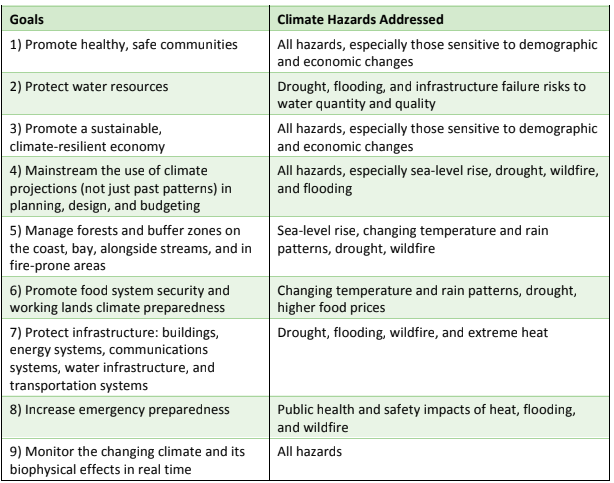
In its final section, entitled “Actions for Climate Resilience”, the plan presents several ways of organizing its key recommendations. Actions are delineated that can be taken to reach the goals outlined in the previous section. For instance, the plan suggests improving collaboration between among mosquito abatement, disease vector, and orchard crop experts in order to address the impact of a decreasing number of freezing nights in Sonoma County.
The appendix includes a table showing 50 suggested actions. For each, the table identifies which climate hazard the action addresses, the timeframe in which results would be seen, and insights into the costs and benefits.
Publication Date: April 2016
Authors or Affiliated Users:
- Caitlin Cornwall
- Genevieve Taylor
- Christine Walker
Related Organizations:
- North Bay Climate Adaptation Initiative
Sectors:
- Agriculture and food
- Business
- Forestry
- Rural
- Water resources
Resource Category:
Resource Types:
- Adaptation plan
States Affected:
Impacts:
- Air temperature
- Drought
- Flooding
- Sea-level rise
- Wildfires
