


Maryland Climate Adaptation and Resilience Draft Framework 2021-2030
In 2019, the Maryland Department of the Environment published the Maryland Climate Adaptation and Resilience Draft Framework: 2021-2030 (Framework). The result of a year's worth of working group sessions between representatives from state agencies, local government, non-profit organizations, and academia, the Framework is designed to serve as a statewide guide to help establish ongoing climate adaptation goals through 2030 and beyond.
Each working group throughout the development process was assigned to one of the five sectors or three focus areas. The resulting Framework is broken up into chapters for each sector and focus area with priority goals and identified strategies and activities needed to achieve them for local government, state government, and non-government stakeholders. The sectors include:
- Water Resources;
- Human Health;
- Working Lands & Natural Resources-Based Economies;
- Natural Resources & Ecosystems; and
- Protecting Critical Infrastructure.
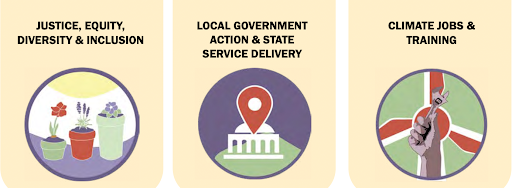
The focus areas were created based on the values and principles that Maryland embraces, summarized in three main groups:
- Justice, Equity, Diversity & Inclusion;
- Local Government & State Service Delivery; and
- Climate Jobs & Training.
These focus areas aim to “holistically incorporate key values that underpin how Maryland will achieve a resilient future”.

|
|
The Justice, Equity, Diversity & Inclusion focus area is a key value that is integrated throughout the Framework to ensure state agencies and local governments throughout Maryland design and implement adaptation strategies that improve outcomes for underserved and overburdened communities. With this focus area, the Framework acknowledges the systemic inequities these communities will continue to face as climate change impacts intensify, calling for a collaborative, interdisciplinary approach to help government programs work together towards equitable adaptation solutions. The Justice, Equity, Diversity & Inclusion section incorporates a number of thought-provoking questions, such as “Who are the most underserved and overburdened communities that will be affected by this climate adaptation proposal?”. This question guide serves as a tool to help evaluate equity concerns and impacts throughout decision-making processes. |
Notably, the Framework focuses on taking an interdisciplinary approach to climate adaptation by outlining strategies for co-creating solutions across all sectors and focus groups. Goal 3 of Local Government Action and State Service Delivery, “Co-Creating Local Adaptation Solutions”, outlines activities to help increase technical support to local governments, foster regional partnerships, and boost local resilience capacity assistance service. Proposed activities include establishing a “resiliency capacity assistance service” to connect local governments to local, federal, and state agencies, and creating a portfolio of local resilience project proposals to improve grant application processes.
In addition to MDE staff, the framework was developed in collaboration with the University of Virginia Institute for Engagement & Negotiation Project, the Maryland Department of Natural Resources, the Maryland Department of Planning, the Maryland Department of Health, the Maryland Department of Agriculture, the Maryland Department of Transportation, the Eastern Shore Land Conservancy, the Maryland Historical Trust, and the University of Maryland Environmental Finance Center. The next framework will be released sometime around 2030.
Publication Date: 2019
Related Organizations:
- Maryland Department of the Environment
Sectors:
- Agriculture and food
- Land management and conservation
- Land use and built environment
- Public health
- Water resources
Resource Category:
Resource Types:
- Adaptation plan
States Affected:
Impacts:
- Flooding
- Heat waves
- Precipitation changes
- Socioeconomic
- Water supply
