


Maryland Plan to Adapt to Saltwater Intrusion and Salinization
Maryland’s Plan to Adapt to Saltwater Intrusion and Salinization, first published in 2019 and updated in 2024, provides recommendations for state-level action to better understand the impacts of increasing saltwater intrusion and salinization on different resources and to adapt to these impacts. Saltwater intrusion in the region is expected to worsen over time due to climate change, and the report describes which of the state’s resources are at greatest risk, adaptation measures that are currently in use and recommended, and what additional research is needed for adequate adaptation and resilience. The plan offers adaptation strategies specifically for Aquifers, Surface Water, Agriculture, Coastal Wetlands, Coastal Forests, and Infrastructure.
Maryland HB 1350 created the requirement for a Maryland plan to adapt to saltwater intrusion by the end of 2019 due to the increase in sea level rise and coastal flooding events. The plan is required to be updated at least every five years, with this 2024 version representing the first update. The Chesapeake Bay is the third most vulnerable area in the U.S. to sea level rise (SLR) and projections for Maryland of up to 1.6 ft SLR by 2050 and up to 4.2 ft SLR by 2100 are expected. Sea level rise and more frequent and intense storms due to climate change are increasing the problem and threat of saltwater intrusion into freshwater aquifers and salinization of fresh surface and soil waters. Saltwater intrusion and salinization affect drinking water and agricultural irrigation sources, make coastal farmland unusable, alter coastal wetland and forest ecology, and damage infrastructure. Maryland is currently experiencing all of these effects and expects the problems to increase and intensify with the progression of climate change and SLR. The image below illustrates the areas and resources at greatest risk.
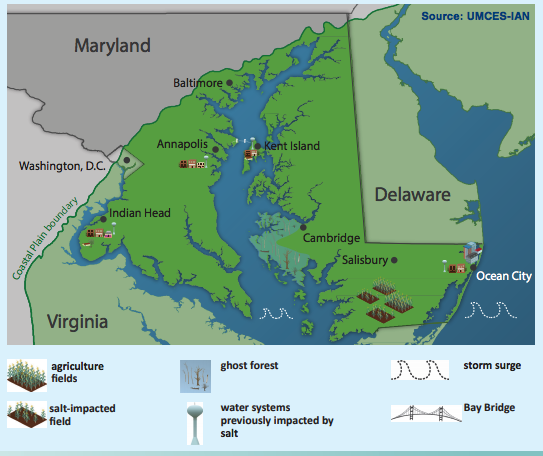
Above: Maryland Salt Water Intrusion Map
The plan is organized by six primary impacted resources including: aquifers, surface waters, agriculture, coastal wetlands, coastal forests, and infrastructure (roads, wells, septic systems and electric systems). Each section includes a description of the resource in Maryland and how saltwater moves into and impacts that resource; the threats, concerns, and impacts of saltwater intrusion and salinization on the resource; research priorities; and priority adaptation strategies for near and long-term planning.
The plan recommends the creation of a Salinity Resilience Network of technical staff, policy-makers, and other stakeholders to ensure an organized long-term effort in implementation and research. The Network would share information and set research priorities, especially focusing on vulnerability assessments, environmental monitoring, forecasting tool development, and effective adaptation interventions.
Appendix A of the plan summarizes and organizes adaptation measures into those that are recommended to implement now, those already being undertaken and which should continue or be used on an as-needed basis, and those that could be further examined to evaluate their use in a Maryland-specific context. Examples of priority adaptation strategies recommended to implement now include:
Farmers/Agricultural Land
- Compare federal and state programs supporting land use transitions for salt-impacted farmland and provide best practice guidance.
- Expand farmer education on salinization, including soil testing, salt-tolerant crops, restoration strategies, and available financial and technical support.
- Promote advanced water control structures to prevent saline water intrusion, develop mapping tools to track saltwater spread, and advocate for crop insurance or compensation for lost farmland.
Wetlands
- Develop a statewide wetland adaptation plan, which would include identifying opportunities for migration of coastal wetlands, and in some cases, measures to make high priority wetlands more resilient.
Coastal Forests
- Facilitate alternative uses for inundated forest land, such as promoting sika deer or duck hunting.
- Establish additional education and assistance for forest landowners to address and prepare for salinization, including development of a landowners’ outreach program.
Infrastructure
- Educate coastal property owners on risks from saltwater intrusion, soil salinization, and sea level rise; provide resources for inspections, repair planning, and structural longevity estimates.
- Collaborate with insurance companies and government agencies to explore coverage options, facilitate discussions on adaptation strategies, and secure financial and technical assistance for infrastructure protection.
Appendix A offers a summary of the plan’s research priorities and adaptation recommendations as well as a list of technical and financial resources. Appendix B offers a progress update in implementing the initial 2019 plan. Appendices C and E offer additional adaptation policies and measures that could be considered, including for protecting high priority wetlands in place. Finally, Appendix D provides additional details on saltwater intrusion in aquifers.
The plan was prepared by the Maryland Department of Planning, in consultation with the Departments of Natural Resources, Environment, and Agriculture.
Publication Date: December 2024
Related Organizations:
- Maryland Department of Planning
Related Resources:
Sectors:
Resource Category:
Resource Types:
- Adaptation plan
- Assessment
States Affected:
Impacts:
