


Woodbury, New Jersey: Ordinance No. 2386.23 - Freeboard Regulations
This resource is part of a collection of research on Local Ordinances for Climate Adaptation & Mitigation developed by Georgetown Climate Center. See more related resources.
The City of Woodbury, New Jersey, passed Ordinance no. 2386.23 in May 2023, introducing new regulations for development in flood hazard areas. Most notably, the ordinance establishes additional freeboard for critical facilities, and directly points to the authority of the American Society of Civil Engineers in its standard for Flood Resistant Design and Construction (ASCE 24) as the explanation for doing so. The ordinance is codified in the Woodbury, NJ municipal code in Chapter 92, Flood Damage Prevention.
Ordinance 2386.23 comprehensively manages flood hazards through a variety of provisions, including flood hazard mapping, development restrictions, permitting requirements, and design standards. Design standards are included for various different infrastructure elements such as sewer facilities (§401.2), water facilities (§401.3), sidewalks (§401.5), storage tanks (§701.1), fences (§801.4), and roads (§801.7). These standards draw upon ASCE 24 as well as other New Jersey laws, such as the Flood Hazard Area Control Act and the Uniform Construction Code, in order to increase resilience of the structures to flooding.
Figure: FEMA Flood Hazards in Gloucester County, New Jersey
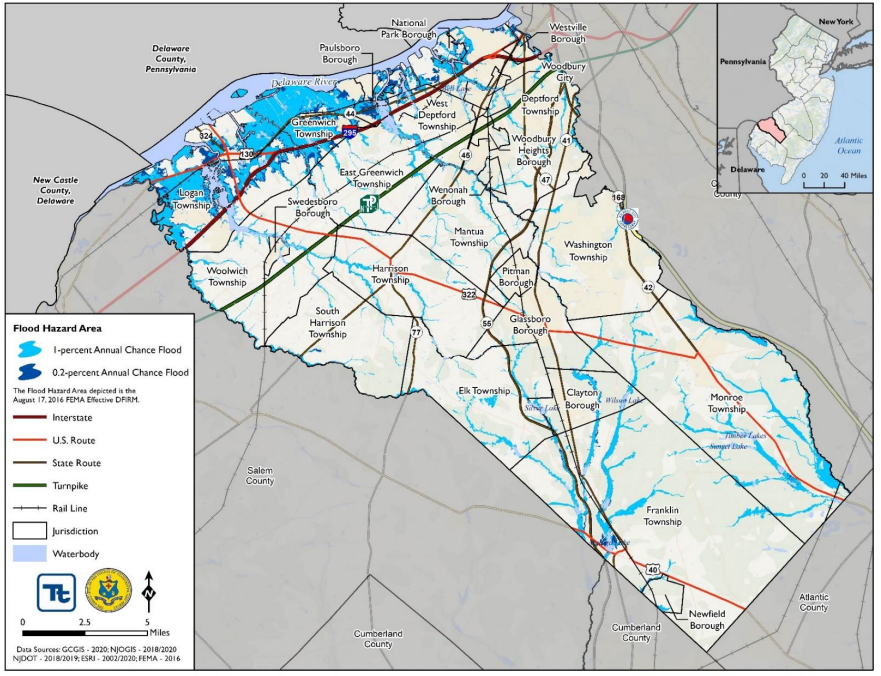
Image caption: 100- and 500-year floodplain for Gloucester County from the 2022 Hazard Mitigation Plan Update. Woodbury, NJ in the northern tip of the highlighted area.
Mapping
The City of Woodbury is subject to the New Jersey Flood Hazard Area Control Act (FHACA) in its establishment of flood hazard areas. The FHACA requires that the most stringent mapping is chosen through comparison of the effective Flood Insurance Rate Map, the most recent FEMA mapping and studies, and the New Jersey Department of Environmental Protection’s delineations. Because of this standard, New Jersey flood hazard areas may be more expansive than FEMA Special Flood Hazard Areas. Within its own jurisdiction, the City of Woodbury identifies sources, which include the best available federal and state data, that must be considered to determine the “Best Available Flood Hazard Data Area”.
The FHACA also designates a “Flood Hazard Area Design Flood Elevation” which is required for state-regulated waters and may be used as the flood elevation for undelineated watercourses. The Flood Hazard Area Design Flood Elevation is the peak water surface elevation that occurs during the “flood hazard area design flood”, which is a 100-year flood which accounts for potential worsening of flooding conditions due to climate change or development.
Freeboard Standards
The ordinance designates Local Design Flood Elevations (LDFEs) with differing levels of freeboard for different types of facilities and areas of development. Critical facilities must have additional freeboard, as is specified by ASCE 24. Class IV Critical Facilities (facilities essential to emergency response or community function such as hospitals, fire stations, or emergency shelters) must have an LDFE aligning with either the 500-year (0.2% chance) flood elevation or the Flood Hazard Area Design Flood Elevation plus two feet of freeboard, whichever is higher. Class III Critical Facilities (facilities that if damaged or unavailable would be disruptive to the community such as museums or schools) must have an LDFE aligning with either the 500-year (0.2% chance) flood elevation or the Flood Hazard Area Design Flood Elevation plus one foot of freeboard, whichever is higher.
In special river or stream flood hazard areas as designated by FEMA, the LDFE must be “the highest adjacent grade plus the depth number specified plus one foot of freeboard,” or three feet above the highest adjacent grade if no depth number is available.
Where there is a delineated watercourse, the LDFE corresponds to one foot of freeboard on top of the elevation in the Best Available Flood Hazard Data Area. In undelineated watercourse areas, the regulations require applicants to determine the LDFE and add additional freeboard in accordance with ASCE 24.
Publication Date: May 15, 2023
Related Resources:
Sectors:
Resource Category:
Resource Types:
- Laws
States Affected:
Impacts:
- Flooding
- Riverine Flooding
