


Exceeding Minimum Standards for Local Floodplain Ordinances: 11 Examples
Georgetown Climate Center studied local ordinance-centered approaches to reducing greenhouse gas emissions and identifying and reducing climate-driven flood risk in an October 2025 report, “Local Ordinances for Climate Adaptation & Mitigation.” As part of that project, GCC’s research identified 11 ordinances from Connecticut, Florida, Maryland, New Hampshire, and New Jersey that represent some of the best uses of local ordinances to advance climate adaptation and protect people and property.
Over the past 50 years, scientists have observed a significant surge in weather-related disasters and other trends attributable to climate change, including rising coastal sea levels, increased intensity of storm surges, and more variable and intense precipitation events.
Each year, flooding from storms becomes more frequent and severe. As the climate continues to change, so will the intensity of storms and their impacts to riverine and coastal communities. With each new catastrophic flooding event, people are displaced, insurance prices rise, municipal bond ratings fall, and infrastructure is less able to withstand the damage. Preventing more development in areas at risk of consistent flooding, and building with more resilient standards, will help coastal and riverine communities save money and lives. States and localities can steer construction away from flood-prone areas with forward-thinking floodplain management.
The Federal Emergency Management Agency (FEMA), requires National Flood Insurance Program (NFIP) participating communities to adopt floodplain management practices that meet federal standards. States can choose to adopt standards that exceed federal requirements and provide a heightened baseline for local governments within their jurisdiction.
Local floodplain ordinances provide the legal mechanism for formalizing requirements to identify and address risk
The examples linked below include ordinances that:
- Expand the mapped floodplain;
- Expand the regulatory floodplain;
- Require new construction, and retrofits, within that floodplain to meet freeboard, or elevation, standards;
- Require new construction to meet minimum setback standards to keep property away from floodwaters; and,
- Incorporate community engagement for floodplain management.
Click on the locality name for specific examples of these local ordinances:
- Avalon, NJ: Significantly exceeds minimum freeboard standards and regulates the 500-year floodplain as opposed to the required 100-year floodplain.
- Frederick, MD: Requires setbacks of up to 100 feet from watercourses and flood hazard areas.
- Hampton, NH: Incorporates future sea-level rise into the town’s regulatory boundaries and freeboard requirements.
- Havre de Grace, MD: Prohibits critical facilities from being built in coastal areas with high flood risk, and requires any exceptions to elevate structures to the 500-year flood level.
- Laurel, MD: Establishes a setback of up to 100 feet in flood hazard areas, and mandates that critical and essential facilities be elevated above flood levels determined by the city’s Building Code, or the 500-year flood level, whichever is higher.
- Ocean City, MD: Creates tailored freeboard zones, sets minimum construction standards and designates “Critical Foundation Areas” where development is prohibited.
- Satellite Beach, FL: Prohibits certain facilities being built in the 500-year floodplain, and updated freeboard requirements to account for coastal flooding and future sea-level rise.
- Satellite Beach, FL: Utilized community engagement to adopt a shared planning horizon and sea-level curve for floodplain management purposes.
- Satellite Beach, FL: Adopted “Adaptation Action Areas” to target design and development standards in areas most at risk for erosion and inland flooding.
- West Hartford, CT: Sets specific regulatory boundaries for development around stream channel encroachment lines and areas mapped for water quality concerns.
- Woodbury, NJ: Establishes specific freeboard requirements, well beyond the federal minimum, for different types of facilities following model language from the American Society of Civil Engineers.
Figure: Example climate-adjusted freeboard elevation for New Jersey
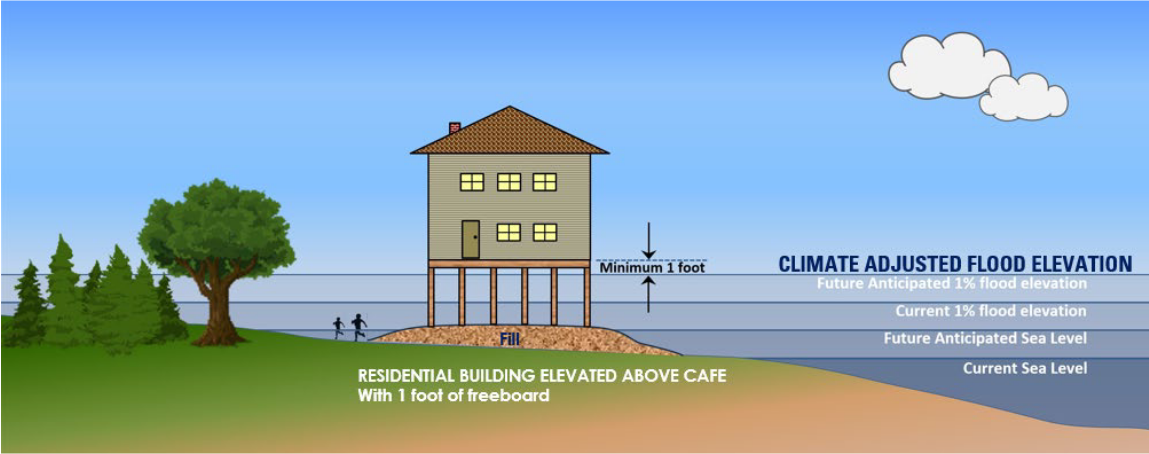
Graphics from the New Jersey Department of Environmental Protection Resilient Environment and Landscapes (NJDEP REAL) Webinar 1: Sea Level Rise & Inundation Risk Zone, May 20, 2024.
For more resources related to local floodplain management, see the Local Ordinances for Climate Adaptation page.
Publication Date: October 31, 2025
Related Organizations:
Related Resources:
- Satellite Beach, Florida: Floodplain Management Ordinance
- Ocean City, Maryland: Flood Damage Prevention Ordinance
- Hampton, New Hampshire: 2025 Zoning Ordinance, Building Codes, and Impact Fee Ordinance
- Frederick County, Maryland: Floodplain District Standards
- Woodbury, New Jersey: Ordinance No. 2386.23 - Freeboard Regulations
- West Hartford, Connecticut: Special Flood Hazard Area Regulations
- Borough of Avalon, New Jersey: Flood Damage Prevention Ordinance
- Satellite Beach, Florida: Ordinance No. 1159 - Setback Standards and Community Engagement
- Satellite Beach, Florida: Ordinance No. 1113: Adaptation Action Areas and Community Engagement
- Laurel, Maryland: Code Article IV. - Floodplain Management
Sectors:
Resource Category:
Resource Types:
- Case study
- Laws
- Legal Analysis
States Affected:
Impacts:
- Flooding
- Coastal Flooding
- Riverine Flooding
- Sea-level rise
