Communication, Community Participation, and Outreach
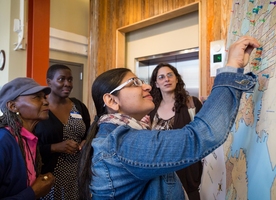
This tab provides information on how to work with frontline communities, the public and other stakeholders to understand and address climate vulnerabilities.
Resources are automatically presented by date. Apply additional filters to narrow the list by organization type of author, state, jurisdictional focus, region, or resource type.
85 results are shown below.
Filter by States AffectedSelect states to filter this list
All
Alabama Alaska American Samoa Arizona Arkansas California Colorado Connecticut Delaware District of Columbia Florida Georgia Guam Hawaii Idaho Illinois Indiana Iowa Kansas Kentucky Louisiana Maine Maryland Massachusetts Michigan Minnesota Mississippi Missouri Montana Nebraska Nevada New Hampshire New Jersey New Mexico New York North Carolina North Dakota Northern Marianas Islands Ohio Oklahoma Oregon Pennsylvania Puerto Rico Rhode Island South Carolina South Dakota Tennessee Texas Utah Vermont Virgin Islands Virginia Washington West Virginia Wisconsin Wyoming
Resource
April 29, 2019
From the National Association for the Advancement of Colored People (NAACP), this comprehensive Toolkit provides a series of modules to help NAACP chapters and other advocates mediate climate adaptation planning processes and ensure that adaptation plans and policies meet local needs, while focusing on frontline communities, environmental and climate justice, and equity. The Toolkit provides guidance to help community groups and advocates develop an Environmental and Climate Justice (ECJ) Committee to inform adaptation planning and policy through 19 different Modules.
Author or Affiliated User: Jacqui Patterson
Resource Category: Planning
See Resource Login to Add to My Resource List
Resource
In 2009, the Chicago 49th Ward Alderman, Joe Moore launched the first participatory budgeting process in the United States in the City of Chicago, Illinois. When participatory budgeting was first introduced in the City, Alderman Moore used the process to engage with his constituents regarding how the community would spend its $1.3 million in discretionary capital funds. Since this initial introduction, the participatory budgeting process in Chicago has proved a rousing success. In 2012, the Great Cities Institute partnered with the Participatory Budgeting Project and community-leaders from the area to launch PB Chicago to spread the budgeting process throughout the city. PB Chicago has now engaged with over 13,000 residents in 12 different communities, allocating over $18 million in funding to community-chosen projects varying from tree planting to establishing bike lanes. By focusing a majority of their outreach on marginalized and underserved communities, PB Chicago ensures not only that policymakers and city officials hear these residents’ voices, but that these same voices have the opportunity to effectuate change within their own communities as well.
Resource Category: Funding
See Resource Login to Add to My Resource List
Resource
2019
In 2019, the Union Square Neighborhood Council (USNC) negotiated and ratified a Community Benefits Agreement (CBA) with the developer Union Square Station Associates LLC (US2), following approximately a year of weekly meetings with the negotiating committee. The CBA set forth terms on a number of issues, including housing, workforce development, and environmental sustainability. Specifically, under the CBA, US2 committed to developing 90 permanently affordable units in the Union Square neighborhood (out of a total of 1,000 new affordable and market rate units).
Resource Category: Solutions
See Resource Login to Add to My Resource List
Resource
August 7, 2018
The Resilient Puerto Rico Advisory Commission - a collaborative of leaders from Puerto Rico’s businesses, government, and NGOs - came together with local communities after Hurricane Maria to determine how to best rebuild Puerto Rico as a more physically, economically, and socially resilient island. The Commission released ReImagina Puerto Rico as a guide to resilient recovery and reconstruction. The report offers recommendations for how to maximize philanthropic, local government, and federal recovery funds.
Resource Category: Solutions
See Resource Login to Add to My Resource List
Resource
2018
The Los Angeles County, California, Department of Regional Planning (DRP) developed the Green Zones Program in 2015, to
Resource Category: Solutions
See Resource Login to Add to My Resource List
Resource
Formed in 2006, the Community Water Center (CWC) is a grassroots organization in California’s Central Valley that works to combat water insecurity in frontline communities through community organizing, policy advocacy and public education to influence water governance and decision making. Many residents of the Central Valley are from low income, predominantly Latinx communities that deal with water scarcity, groundwater contamination, or a lack of proper infrastructure. CWC provides technical and legal assistance for frontline communities, training residents as clean water advocates and helping to secure funding for sustainable drinking water projects.
Resource Category: Solutions
See Resource Login to Add to My Resource List
Resource
2018
The District of Columbia Public Service Commission’s (DCPSC) establishment of the Customer Impact Working Group within the Modernizing the Energy Delivery System for Increased Sustainability (MEDSIS) initiative is a replicable example of how utility commissions are working to invite equitable input in grid modernization efforts. DCPSC initiated the MEDSIS initiative as a means of making the energy delivery system more sustainable, reliable, efficient, cost effective, and interactive for District customers. DCPSC approved the establishment of six working groups to elicit input from a diverse range of stakeholders in order to address key issues related to modernizing the District’s energy delivery system. The Customer Impact Working Group is examining how grid modernization efforts may impact various customers, including exploring questions of customer equity, data protection and privacy, consumer protection, and low- and limited-income customer inclusion. This Working Group will produce recommendations aimed at ensuring that all customers benefit from grid modernization efforts.
Resource Category: Planning
See Resource Login to Add to My Resource List
Resource
June 2018
Recognizing the importance of collaborative governance in reducing inequities as a result of climate vulnerability, the Urban Sustainability Directors Network gave the Innovation Fund Project grant to four municipal community-based committees for racial equity and environmental justice. They were funded to learn and evaluate the collaboration process between community-based committees and the local governments utilizing the spectrum of community engagement to ownership as a tool to analyze the case studies. The four case studies include the Equity Working Group in Portland, the Racial and Environmental Justice Committee in Providence, the Environmental Justice Committee in Seattle, and the Equity Advisory Group for Ward 7 in Washington DC . The four committees and groups contracted with Facilitating Power (FP), Movement Strategy Center (MSC), and the National Association of Climate Resilience Planners to establish an evaluation process of collaborative governance. After conducting surveys and in-person interviews, the research indicates that all four cases are still at level two (consult) on a scale of five on the spectrum. While some have shown the potential of moving toward level three (community involvement), none of these cases have arrived at level four (collaborative governance). Building on the findings and the spectrum, the project further suggests a learning and evaluation tool for assessing the process of collaborative governance.
Resource Category: Data and tools
See Resource Login to Add to My Resource List
Resource
May 2018
Resource Category: Solutions
See Resource Login to Add to My Resource List
Resource
2018
The Louisiana Strategic Adaptations for Future Environments (LA SAFE) planning process is aimed at climate adaptation and resilience planning for coastal communities in Louisiana. The strategy supports mitigating risks and increasing resilience to coastal impacts - especially flooding. The LA SAFE initiative was first funded through a HUD long-term disaster recovery grant, for six parishes most impacted by Hurricane Isaac in 2012. Guided by the state of Louisiana, and a network of regional non-profits focused on coastal restoration and resilience, it is a goal of the LA SAFE program to expand the program statewide in the future.
Resource Category: Solutions
See Resource Login to Add to My Resource List