Communication, Community Participation, and Outreach
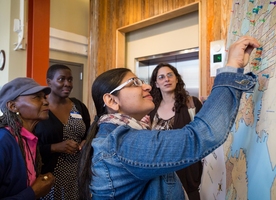
This tab provides information on how to work with frontline communities, the public and other stakeholders to understand and address climate vulnerabilities.
Resources are automatically presented by date. Apply additional filters to narrow the list by organization type of author, state, jurisdictional focus, region, or resource type.
85 results are shown below.
Filter by States AffectedSelect states to filter this list
All
Alabama Alaska American Samoa Arizona Arkansas California Colorado Connecticut Delaware District of Columbia Florida Georgia Guam Hawaii Idaho Illinois Indiana Iowa Kansas Kentucky Louisiana Maine Maryland Massachusetts Michigan Minnesota Mississippi Missouri Montana Nebraska Nevada New Hampshire New Jersey New Mexico New York North Carolina North Dakota Northern Marianas Islands Ohio Oklahoma Oregon Pennsylvania Puerto Rico Rhode Island South Carolina South Dakota Tennessee Texas Utah Vermont Virgin Islands Virginia Washington West Virginia Wisconsin Wyoming
Resource
2018
The Massachusetts Greening the Gateway Cities Program (GGCP) aims to increase tree canopy cover in the state’s Gateway Cities, which are urban centers facing economic and social challenges due to recent losses in industry and manufacturing power. The program is currently operating in 18 residential areas with the goal of covering 5% of each area in new tree canopy cover. This initiative aims to reduce heat stress as well as energy use and cost for Massachusetts residents.
Resource Category: Funding
See Resource Login to Add to My Resource List
Resource
December 2017
Carpe Diem West presents seven case studies of local water resilience/conservation initiatives across the western U.S. in this online resource. The organization’s 10th year anniversary report is a presentation of successfully implemented solutions for adapting our water usage to the changing climate. These seven stories highlight strategies that are grounded on the principles of equity, collaboration and sustainability.
Resource Category: Solutions
See Resource Login to Add to My Resource List
Resource
2017
The Upper Manhattan Climate Action Manual describes building resilience to climate change in Upper Manhattan and greater New York City. The manual was designed to complement the Northern Manhattan Climate Action Plan produced in 2015, and further connects climate change resiliency, preparedness, and addressing social inequality in New York City.
Author or Affiliated User: Aurash Khawarzad
Resource Category: Planning
See Resource Login to Add to My Resource List
Resource
August 2017
The Green City Coalition (Coalition) -- a partnership between the Metropolitan Sewer District, the City of St. Louis, Missouri Department of Conservation, and the St. Louis Development Corporation -- is leading the conversion of approximately 9 acres of vacant land into greenspace for stormwater management and recreation purposes. The Wells Goodfellow neighborhood in St. Louis has the highest proportion of vacant land in the city, and also struggles with combined sewer overflows, basement backups, and street flooding that affect the Bissell Point Watershed broadly.
Resource Category: Solutions
See Resource Login to Add to My Resource List
Resource
2011
In 2011, four New York City Council Members partnered with several community-based organizations and launched a Participatory Budgeting process to allow residents to vote to allocate a portion of the council’s capital discretionary funds. The Participatory Budgeting New York City (PBNYC) process involved the city allocating funds to finance physical infrastructure projects, such as schools, parks, and public housing that benefit the public, that cost at least $50,000 and have
Resource Category: Funding
See Resource Login to Add to My Resource List
Resource
May 18, 2017
In 2017, the District of Columbia’s Departments of Energy & Environment (DOEE) and Employment Services (DOES) partnered with GRID Alternatives Mid-Atlantic to start Solar Works DC, to implement a low-income solar installation program with a job training component. The purpose of the Program is to focus on training disadvantaged members of the D. C. community in solar installation, and provide low-income families with solar energy systems. Over a three-year period, more than 200 individuals have been trained in solar-related related industries.
Resource Category: Education and Outreach
See Resource Login to Add to My Resource List
Resource
2016
The Harlem Heat Project is a community-based initiative that began in New York City in the summer of 2016. It combines crowd-sourcing, data reporting, and narrative journalism to tell the story or urban heat islands in New York City. Non-profit journalism and community-based organizations came together to provide low-cost heat sensors to homeowners in "heat-vulnerable" areas of Harlem in New York City. The data was used to tell the story of disproportionate risks to extreme heat for lower-income and communities of color as a result of increasing temperatures from climate change.
Resource Category: Solutions
See Resource Login to Add to My Resource List
Resource
2017
Adapt Alaska is a website which hosts information about climate impacts in Alaska, a set of steps for policymakers and planners to create monitoring, mitigation, and adaptation solutions, and various resources and case studies designed to guide the user in developing and funding their own adaptation projects. The website emerged from a collaborative research project—Promoting Coastal Resilience in Arctic Alaska— which included workshops and outreach efforts, during which coastal community resilience workshop participants identified issues they faced from rapidly changing environmental and climate conditions. This learning and planning tool provides both background information about the impacts of climate change on Alaska and resources to adapt to this change, while incorporating considerations of cultural values into strategies.
Resource Category: Adaptation Websites
See Resource Login to Add to My Resource List
Resource
2017
Climate Resilient and Equitable Water Systems (CREWS) consists of 24 nonprofits - Kresge Foundation grantees - who are building solutions for low-income communities in U. S. cities to adapt to climate enhanced storm and flood impacts. CREWS programs are transforming urban stormwater and wastewater systems with climate resilient integrated water-management practices and socially equitable solutions. CREWS is an initiative of the Kresge Foundation’s Environment Program, focused on climate resilience through adaptation, mitigation, and social justice.
Resource Category: Solutions
See Resource Login to Add to My Resource List
Resource
December 2016
The U.S. Environmental Protection Agency (EPA) has developed climate communication materials that summarize key points from the USGCRP U.S. Climate and Health Assessment for the different populations that are disproportionately affected by climate-change impacts. The assessment provides a comprehensive analysis of observed and projected health impacts from climate change, and specifies the impacts on a range of vulnerable populations. The eight assessment kits distill this information and focus on the climate impact attributes respective to each population of concern, while offering educational materials and communication strategies.
Resource Category: Education and Outreach
See Resource Login to Add to My Resource List