


*HOLD* Climate Resiliency - Design Reference Guide for New Developments in Boston, Massachusetts
The Boston Environment Department developed this Reference Guide to help developers comply with the Resilient Design Checklist required by updates to Article 80 of Boston's Zoning Code and the Green Building Standards required by amendments to Article 37 of the City's Zoning Code. The Reference Guide helps developers evaluate the project site and design conditions, identify mitigation and adaptation strategies to incorporate into the project design, and access resources to help comply with the City's resilience and green building design requirements.
The Reference Guide includes the following sections:
- Understanding Flood Risks - to help developers assess and address sea-level rise impacts to a project by elevating the first floor of the structure and mechanical and electrical systems to a sea-level rise design elevation (at least 40 inches above the base flood elevation for the 100-year flood event).
- Green Building - to help developers evaluate and enhance the sustainability and efficiency of the building envelope (foundation, roof, walls, and windows) and energy loads and performance.
- Greenhouse Gas Emissions - to help developers report on the greenhouse gas emissions generated by a project and identify energy reduction strategies.
- Wet Floodproofing - to help homeowners and businesses prevent flood damage to unoccupied, lower areas in a structure, such as crawlspaces.
- Extreme Heat Events - to help developers evaluate building performance based upon changes in average annual temperatures and number of extreme heat days, and incorporate building design and landscaping solutions to mitigate urban heat islands and reduce building temperatures, including: tree cover, plantings, cool pavements, green roofs, cool roofs, high albedo materials, green walls, exterior shading, and operable windows.
- Precipitation - to help developers increase onsite retention of stormwater and reduce runoff, including by incorporating flood resilience and green infrastructure approaches such as bioswales, levees and berms, permeable pavements, vegetation plantings, living shorelines, rain gardens, emergency power systems, sump pumps, and other features.
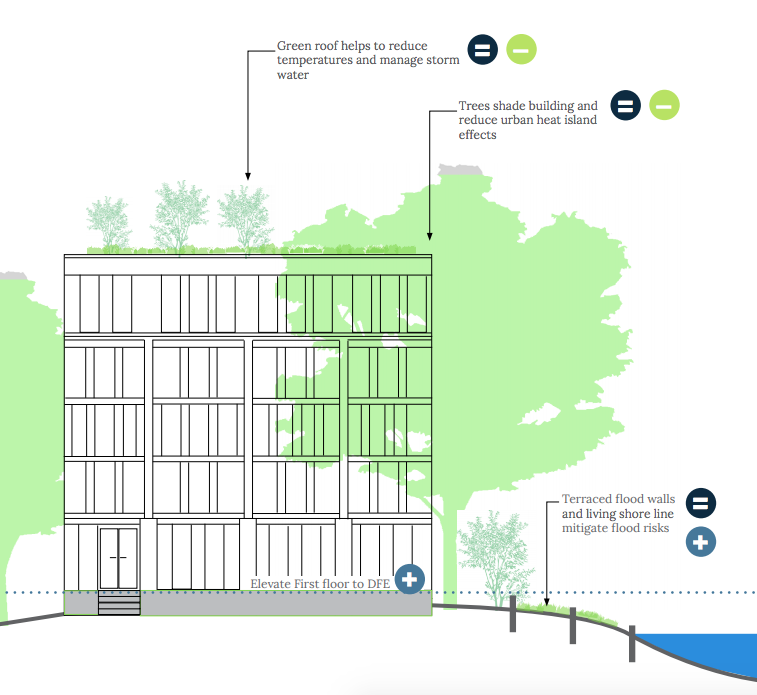
The Guide also includes case studies of different buildings that have incorporated resilience and sustainability features including Spaulding Hospital and the Clippership Wharf in East Boston.
Publication Date: August 2018
Related Organizations:
- City of Boston, Massachusetts
Related Resources:
Related Toolkits:
Sectors:
Resource Category:
Resource Types:
- Agency guidance/policy
States Affected:
Impacts:
- Air temperature
- Extreme storms and hurricanes
- Flooding
- Heat waves
- Precipitation changes
- Sea-level rise
