


Samish Indian Nation Climate Change Vulnerability Assessment
The Samish Indian Nation have lived along the Salish Sea of Washington State “since time immemorial,” and are experiencing the impacts of climate change on their ancestral lands, waters, communities, wildlife, culture, and way of life. The Samish Indian Nation Climate Change Vulnerability Assessment was developed to provide the tribe with an understanding of how climate change will impact important resources, and to highlight areas that need further research and adaptation planning. It was prepared through collaboration of the Samish Indian Nation staff and Tribal community members led by the Samish Climate Change Working Group. The assessment provided a qualitative vulnerability and risk assessment of 209 planning areas relating to the Natural Environment, Human Environment and Built Environment as part of adaptation planning for the Samish Tribe.
The vulnerability assessment addresses key planning areas, in order to set priority goals in formulating adaptation strategies for inclusion in the Tribe’s first adaptation plan. The integrated planning process aims to ensure sustainability of resources for the next seven Samish generations facing the ongoing challenges of climate change. The assessment provides an extensive evaluation of each planning area based on a qualitative assessment framework from the 2007 publication entitled Preparing for Climate Change: A Guidebook for Local, Regional and State Governments and other assessment tools including the The Institute for Tribal Environmental Professionals Climate Change Adaptation Planning Toolkit. The assessment studied the impact of several climate change related stressors affecting each planning area and determined their sensitivity and adaptive capacity arriving at different rankings from low, medium to high. In addition to rankings of vulnerabilities, the assessment also suggested potential adaptation strategies which may be considered in the formulation of the Tribe’s first adaptation plan.
Three primary planning areas of Human, Built, and Natural Environments were assessed as follows:
Human Environment
Human Environment considers the health and well being of the Samish Tribe including human health and community and cultural wellbeing.
Human Health assessments include that of respiratory disease, chronic disease, heat-related illness, extreme weather events, infectious disease and mental and behavioral health. A high vulnerability rating was assigned for the Tribe’s mental and behavioral health, as found to be most impacted by climate change.
Community and Cultural Wellbeing assessments found highest vulnerability ratings for cultural and historic sites, burial sites and ancestral remains, and cultural use of plants.
The assessment also shows that many culturally important natural resources are threatened by climate change which may be lost in the near or long term, leading to the loss of stories and cultural history. In addition, climate change threatens the Tribes’s ability to locate and harvest, for extreme weather may restrict or destroy access to gathering areas. Noticeably, high heat or rainfall may also cause some species to temporarily disappear such as the Indian celery or biscuitroot in Q’exmin. Timing of harvesting of culturally critical resources such as cedar bark, Labrador tea, salmon or shellfish may also be greatly affected.
Built Environment
The Built Environment assessment examined the potential impact of climate change to Samish owned properties and other important regional infrastructure.
Samish Owned Properties assessment found that the Fidalgo Bay and the Huckleberry are the most vulnerable to climate change with highest vulnerability rating.
The Transportation assessment included the potential impact of sea-level rise, coastal and riverine flooding and other climate change related hazard to transportation systems and transportation infrastructure, such as state highways and Interstate 5, local roads, public transportation, and marine transportation. It was found that that the transportation system in general is relatively vulnerable with a medium-high rating
Community Planning and Utilities included assessment of floodplain infrastructure, freshwater, wastewater and sanitary system, and electricity. They found that all of these systems are highly vulnerable, and given a high vulnerability rating.
Natural Environment
The Natural Environment assessment evaluated resources and places in the Salish Sea and also identified plants and animal species considered culturally, historically or ecologically important, outside from Human Environment and Built Environment. Many culturally important natural resources are threatened by climate change in the near and long term. Any loss of these species represents at the very least a loss of stories and cultural history.
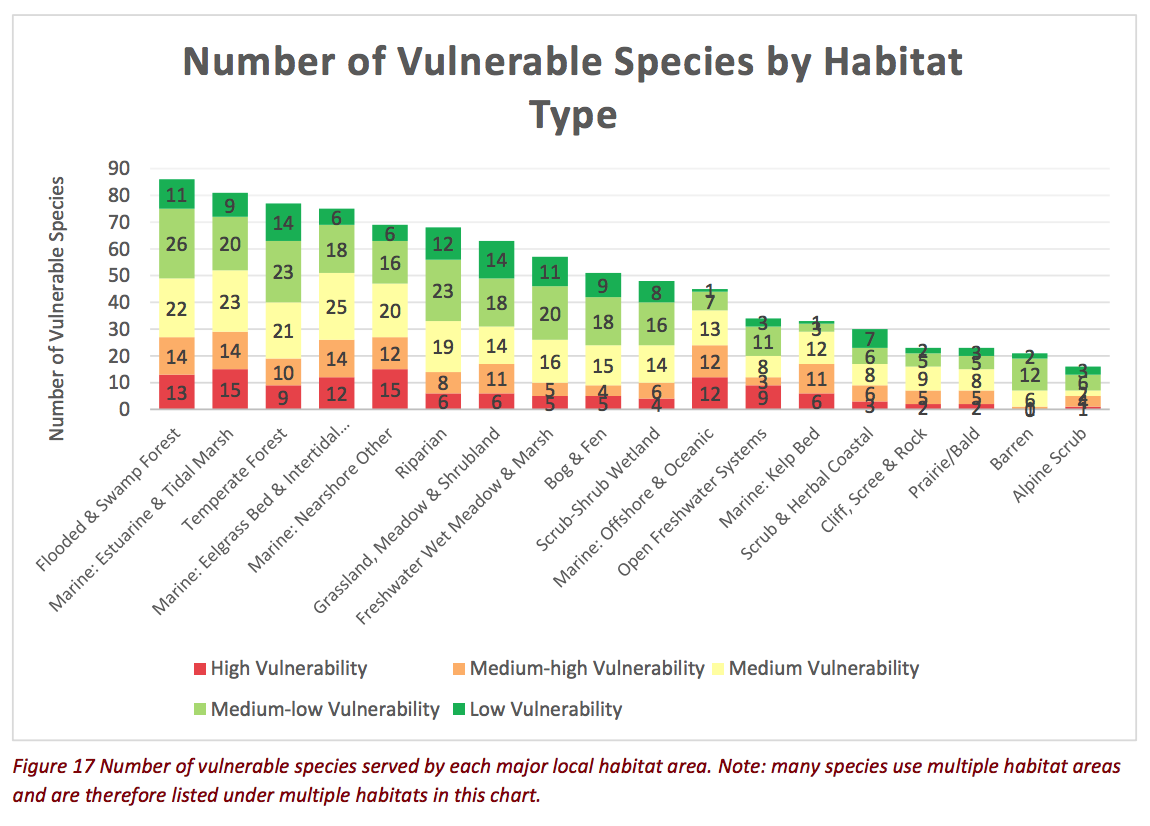
The assessment incorporates a habitat based resiliency analysis involving 7 terrestrial habitats, 5 marine habitats and 6 freshwater habitats. It aimed to identify the habitat types which have the greatest number of vulnerable species. The assessment included 166 plant and animal species including 3 amphibians, 34 birds, 26 fishes, 2 fungi, 4 terrestrial invertebrates, 18 aquatic invertebrates, 19 mammals and 60 plants.
The study found that 29 of 166 species were highly vulnerable to the impacts of climate change by the end of the century and nearly two thirds were determined to be between medium to highly vulnerable to current and future impact of climate change. Salmon species are the most highly threatened of all fish included in this assessment. Because they are a freshwater/saltwater species, they will experience climate impacts across all stages of their life cycles. Increasing ocean temperature, acidity, overfishing, disease and invasive species migration will put stress on high risk aquatic and semi-aquatic mammals, such as the orcas, sea otters, and beavers.
To support the future prioritization of natural resource adaptation projects, tribal staff listed what habitat areas each of the assessed species commonly utilize, then determined the number of vulnerable species served by each of these key habitat areas, as follows.
The adaptation planning process for the Samish Indian Nation involves several stages and funding. Phase 1 which initially focused on outreach to Samish Tribal members, inventory of culturally important plant and animal species, and the identification of Tribal concerns related to emerging long-term weather patterns were made possible through the FY16 BIA Tribal Resilience Program capacity building (category 9) grant. The Samish Indian Nation Climate Adaptation Planning Framework describes the Tribe’s approach to this process.
Phase 2 which includes this assessment report aims to hire a Resiliency Specialist to work with the Samish Resiliency Working Group, complete a qualitative vulnerability and risk assessment, and develop a Samish Resiliency Plan through a Department of Energy Office of Indian Energy grant.
Publication Date: June 2019
Related Organizations:
- Samish Indian Nation
Sectors:
- Biodiversity and ecosystems
- Coastal
- Cultural resources
- Fish and fisheries
- Land use and built environment
- Public health
- Transportation
- Tribal
- Wildlife
Resource Category:
Resource Types:
- Assessment
States Affected:
Impacts:
- Air temperature
- Extreme storms and hurricanes
- Flooding
- Precipitation changes
- Sea-level rise
- Water quality
