


Satellite Beach, Florida: Ordinance No. 1113: Adaptation Action Areas and Community Engagement
This resource is part of a collection of research on Local Ordinances for Climate Adaptation & Mitigation developed by Georgetown Climate Center. See more related resources.
In May 2016, the City Council of Satellite Beach in Brevard County, Florida approved Ordinance 1113, amending the Infrastructure, Coastal Management and Conservation, Intergovernmental Coordination, and Capital Improvements sections of the town’s Comprehensive Plan to adopt Adaptation Action Areas and a shared planning horizon and sea-level curve for city projects.
Satellite Beach has a history of proactive planning for natural hazards and environmental conservation. Their City Council prioritizes long-term planning strategies when it comes to climate change impacts, including the Comprehensive Plan amendments laid out in this ordinance.
Expanded Regulatory Boundaries
The Infrastructure Element of the Satellite Beach Comprehensive Plan was updated to incorporate Adaptation Action Areas (AAAs) for Inland Flooding (IFAAA) and Erosion (EAAA). The creation of local AAAs, which allow for local governments to designate and prioritize areas at risk of coastal impacts through local planning and zoning, was authorized under Florida law by the 2011 Florida Community Planning Act. These areas are at high risk for flooding from tides, sea-level rise, stormwater, and storm surge, and therefore need additional planning for flood protection. Construction within these AAAs have particular design standards, including consideration of future sea-level rise. At the time that Ordinance 1113 was passed, design and development standards had yet to be determined for EAAAs, but they have since been clarified by Ordinance 1159, passed by the city in 2018. Finally, a restriction was added stating that no public infrastructure or buildings may be built seaward of the city’s Coastal Construction Control Line (CCCL), which was established by the state government in 1981 to prevent risky development close to the shoreline. For buildings already beyond the CCCL, new service standards must be met as outlined in the city’s Land Development Regulations.
The Coastal Management and Conservation Element was also amended to acknowledge the AAAs as part of the city’s natural resource goals. As part of this subset of goals, Policies 1.14.3 - 1.14.18 were added to the Plan. These policies outline the boundaries of the AAAs, processes for using and reviewing the AAAs within city planning, and adaptation strategies for use within AAAs. Policies 1.3.2 - 1.3.5 were also added to the Capital Improvements Element of the Plan to determine the process for prioritizing City projects within the EAAA, specifically projects that include nature-based solutions.
At the end of 2025, when the next Comprehensive Plan update is due, the city will review the usefulness and success of the AAAs as implemented. They will potentially modify or remove the AAAs as needed to fit the city’s future development and conservation needs.
Figure: FEMA Flood Zones for Satellite Beach, Florida
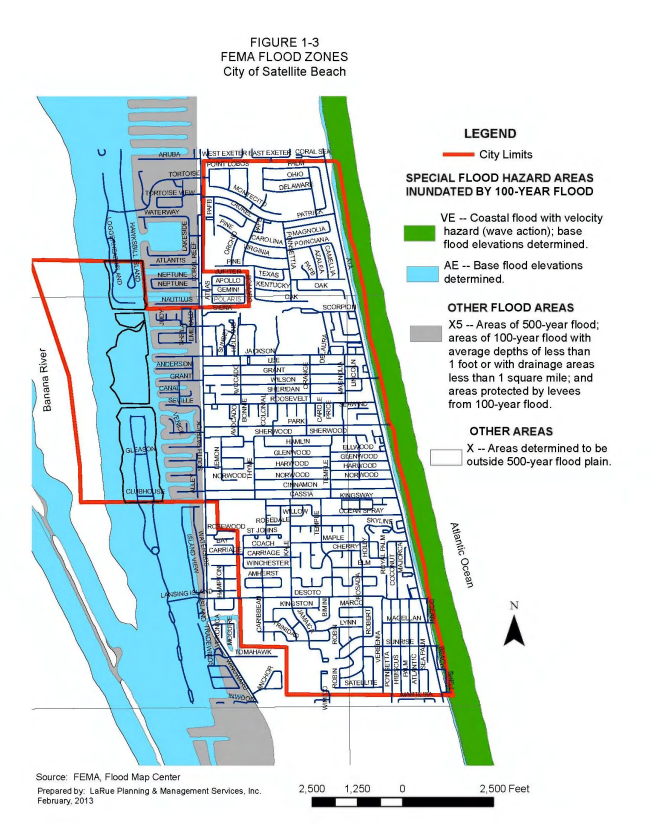
Image caption: From Satellite Beach "Future Land Use Element Goals, Objectives, and Policies" pg. 1-12
Community Engagement
After Satellite Beach residents consistently raised concerns, the city commissioned several studies on the impact to Satellite Beach from rising sea levels. These studies prompted changes to the Comprehensive Plan that are a part of Ordinance 1113. The Infrastructure Element of the Plan was amended to adopt a 2070 planning horizon for future projects with life spans over 50 years that would be built by 2025. Additionally, the ordinance states that the United States Army Corps of Engineers (USACE) “high” sea-level curve should be adopted by the city when determining how much future sea-level rise to plan for. As updated data becomes available, the sea-level projections will be updated, or at least every 5 years.
The Coastal Management and Conservation Element of the Plan additionally established new policies that outline the requirements for community engagement when it comes to AAAs. The city also adopted Policies 1.2.6 - 1.2.9 into the Intergovernmental Coordination Element as part of this Ordinance, requiring that the city, floodplain managers, and stakeholders work together to properly manage flood-prone areas within the IFAAA, and educate property owners on hazard mitigation strategies. The policies also state that the City must replace and mitigate damaged infrastructure after major storms, work with stakeholders to prevent erosion and other coastal hazards, and help beachfront property owners to mitigate coastal hazards using nature-based solutions.
The Comprehensive Plan was first established in 1998 and is updated on a regular schedule. The city’s Comprehensive Planning Advisory Board reviewed these proposed changes in November 2015, after which public hearings were held on proposed amendments in early 2016. The East Central Florida Regional Planning Council, State Land Planning Agency, and other agencies also reviewed these proposed plan updates. The Plan amendments were officially adopted when the plan was approved on May 4, 2016 at the regular City Council meeting.
Publication Date: May 4, 2016
Related Organizations:
- City of Satellite Beach, Florida
Related Resources:
Sectors:
Resource Category:
Resource Types:
- Laws
States Affected:
Impacts:
- Sea-level rise
- Coastal Flooding
- Extreme storms and hurricanes
- Flooding
