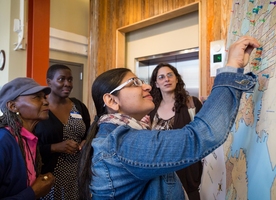
Communication, Community Participation, and Outreach
This tab provides information on how to work with frontline communities, the public and other stakeholders to understand and address climate vulnerabilities.
Resources are automatically presented by date. Apply additional filters to narrow the list by organization type of author, state, jurisdictional focus, region, or resource type.
85 results are shown below.
Filter by States AffectedSelect states to filter this list
All
Alabama Alaska American Samoa Arizona Arkansas California Colorado Connecticut Delaware District of Columbia Florida Georgia Guam Hawaii Idaho Illinois Indiana Iowa Kansas Kentucky Louisiana Maine Maryland Massachusetts Michigan Minnesota Mississippi Missouri Montana Nebraska Nevada New Hampshire New Jersey New Mexico New York North Carolina North Dakota Northern Marianas Islands Ohio Oklahoma Oregon Pennsylvania Puerto Rico Rhode Island South Carolina South Dakota Tennessee Texas Utah Vermont Virgin Islands Virginia Washington West Virginia Wisconsin Wyoming
Resource
Resilient Baton Rouge is a program designed to increase local community capacity in the Baton Rouge area of Louisiana to manage mental and behavioral health in flood-prone parts of the region. By engaging local leaders and healthcare providers, the program has been able to focus on not only delivering mental health services to residents displaced by floodwaters, but also to engage community members in a longer-term process to strengthen both the local communities themselves but also the plans to increase resilience in the region. By deeply engaging affected residents and stakeholders, the plans for resilience broadly are more responsive and targeted to those most affected by the floods. The program is funded by the Robert Wood Johnson Foundation with fiscal sponsorship from the Baton Rouge Area Foundation.
Resource Category: Solutions
See Resource Login to Add to My Resource List
Resource
Miami-Dade County, Florida’s Million Trees Miami initiative aims to plant 1 million trees in lower-income communities with insufficient tree canopy in order to alleviate heat stress in the county. This initiative stems from the County’s 2006 Street Tree Master Plan, which set a goal to achieve 30% tree canopy in Miami-Dade by 2020. Neat Streets Miami, a multi-jurisdictional County Board, is working to implement this goal through the Million Trees Miami initiative. Through a 2016 Urban Tree Canopy Assessment, the County determined that lower-income areas, including predominantly African American and Hispanic neighborhoods, had significantly less tree canopy than their wealthier counterparts. As a result, the County is prioritizing tree planting in its most impoverished and low-canopy areas through initiatives such as the Street Tree Matching Grant. Increased tree canopy cover in communities provides many important adaptation benefits, including protection from flooding, urban heat island mitigation, and improved water and air quality.
Resource Category: Solutions
See Resource Login to Add to My Resource List
Resource
Duke Energy Progress (DEP) worked with the nonprofit, Renewable Energy Transition Initiative (RETI), to increase access to renewable energy programs for lower-income residents. This program provides an example of how utilities can use equity considerations to inform the deployment of renewable energy programs and resources. RETI works to eliminate high energy costs and make renewable energy solutions more accessible through educational programs, community outreach, research, advocacy, and partnerships. RETI promotes income-based applications and brings awareness to this energy saving program through engaging with communities at local community events and churches. DEP and RETI also launched The Shared Solar program for its residential and non-residential customers to be able to share in the economic benefits from a single solar facility. The cost savings from this community solar program are allocated to low-income customers in the company’s territory.
Resource Category: Funding
See Resource Login to Add to My Resource List
Resource
April 2020
The University of Colorado Natural Hazards Center’s “Principles of Risk Communication: A Guide to Communicating with Socially Vulnerable Populations Across the Disaster Lifecycle” concisely reviews approaches on communicating about hazard and disaster risks to socially vulnerable populations across the U. S. It is organized with three principles in mind: (1) Communicating through familiar and trusted messengers; (2) Providing; and (3) Tailoring messages and information pathways to target audiences, especially marginalized and frontline communities.
Resource Category: Education and Outreach
See Resource Login to Add to My Resource List
Resource
January 2020
According to the Energy Democracy Scorecard and Flipbook from the Emerald Cities Collaborative, “Energy Democracy” is defined as an ideal scenario where a frontline community “shifts completely away from an extractive economy, energy, and governance system to one that is regenerative, provides reparations, transforms the power structures, and creates new governance and ownership practices. ” The Energy Democracy Flipbook is designed to help frontline communities, such as low-income people of color, who are vulnerable to climate change to self-evaluate their communities’ energy economy condition.
Authors or Affiliated Users: Anthony Giancatarino, Donna House
Resource Category: Education and Outreach
See Resource Login to Add to My Resource List
Resource
2019
The Jade Greening Initiatives refer to two concurrent initiatives to plan and implement targeted tree planting and greening in the underserved Jade District of outer southeast Portland, Oregon. Residents in the district experience significant economic and health disparities due to historic public disinvestment, its location surrounded by major transportation corridors on all sides, and lack of tree canopy and accessible green space. With assistance from community-based organizations, community members and businesses worked together to set priorities for neighborhood development and greening. Collaboration, planning, and design of new greenspace were supported through the EPA's Greening America's Communities Program and the Oregon Solutions Program.
Resource Category: Solutions
See Resource Login to Add to My Resource List
Resource
December 2019
The Tribal Climate Health Project hosted a series of 10 live, national webinars on Tribal Climate and Health Adaptation (TC&HA) between August to December 2019. These webinars provided training and guidance for tribal-serving health and environmental professionals on the intersection of climate change and tribal health. The trainings included steps, tools, case studies, and other resources on topics including the different climate-related impacts on tribal communities, how to perform vulnerability assessments, and how to form, implement and evaluate adaptation strategies and plans. There were several interactive components of this training, as participants were encouraged each week to discuss related readings, provide their own experiences and findings, and participate in polls, surveys, and other forms of feedback along the entire 10 week training.
Resource Category: Education and Outreach
See Resource Login to Add to My Resource List
Resource
August 2019
To operationalize California’s statewide vision of honoring social equity in the climate adaptation planning and decision-making processes, the Greenlining Institute published Making Equity Real in Climate Adaptation and Community Resilience Policies and Programs: A Guidebook. The guidebook provides detailed step-by-step guidelines for policymakers to ensure social equity is embraced and implemented throughout the adaptation processes, from goal setting, to policy implementation, to outcome evaluation.
Authors or Affiliated Users: Sona Mohnot , Jordyn Bishop , Alvaro Sanchez
Resource Category: Planning
See Resource Login to Add to My Resource List
Resource
2019
In 2019, the Isle de Jean Charles Biloxi-Chitimacha-Choctaw Tribe (IDJC) collaborated with the National Academy of Sciences (NAS) to release a field guide, Preserving Our Place — A Community Field Guide to Engagement, Resilience, and Resettlement: Community Regeneration in the Face of Environmental and Developmental Pressures . IDJC is in the process of relocating from the Louisiana coast to a new community further inland due to significant land loss and flooding impacts. The field guide was developed to serve dual purposes: first, to document the community engagement process that IDJC has developed throughout its resettlement planning process; and second, to provide procedural guidance and lessons learned for communities that are also contemplating large-scale relocation. The field guide can be used by other tribal or frontline coastal communities that are considering potential larger-scale managed retreat or relocation strategies to adapt to climate change impacts like sea-level rise and other stressors and pressures, like environmental justice and encroaching development.
Resource Category: Solutions
See Resource Login to Add to My Resource List
Resource
The Strong, Prosperous, And Resilient Communities Challenge (SPARCC) is an initiative of Enterprise Community Partners, the Federal Reserve Bank of San Francisco, the Low Income Investment Fund, and the Natural Resources Defense Council that supports equitable and resilient regional development policies and investments. SPARCC supports innovative, local efforts in six major cities throughout the country (Atlanta, Chicago, Denver, Los Angeles, Memphis, and the San Francisco Bay Area) to help change the way metropolitan regions grow, invest, build, and prepare for climate change.
Resource Category: Solutions
See Resource Login to Add to My Resource List