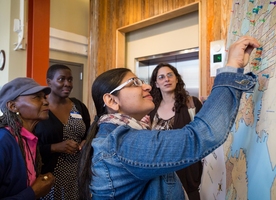
Communication, Community Participation, and Outreach
This tab provides information on how to work with frontline communities, the public and other stakeholders to understand and address climate vulnerabilities.
Resources are automatically presented by date. Apply additional filters to narrow the list by organization type of author, state, jurisdictional focus, region, or resource type.
85 results are shown below.
Filter by States AffectedSelect states to filter this list
All
Alabama Alaska American Samoa Arizona Arkansas California Colorado Connecticut Delaware District of Columbia Florida Georgia Guam Hawaii Idaho Illinois Indiana Iowa Kansas Kentucky Louisiana Maine Maryland Massachusetts Michigan Minnesota Mississippi Missouri Montana Nebraska Nevada New Hampshire New Jersey New Mexico New York North Carolina North Dakota Northern Marianas Islands Ohio Oklahoma Oregon Pennsylvania Puerto Rico Rhode Island South Carolina South Dakota Tennessee Texas Utah Vermont Virgin Islands Virginia Washington West Virginia Wisconsin Wyoming
Resource
The Neighborhood Gardens Trust has been operating as an entity that protects community gardens in the City of Philadelphia since 1986. Working with community gardeners, local leaders, and neighborhood organizations, NGT is a land trust that helps these individuals or groups secure ownership or long-term lease contracts for these gardens to prevent redevelopment or reuse of the land. The organization focuses the majority of its land acquisition and assistance services in lower-income areas throughout Philadelphia, with a specific emphasis on serving underrepresented communities. Since its founding, NGT has protected 48 community gardens throughout Philadelphia, and is on track to protect at least 70 by 2022.
Resource Category: Organizations
See Resource Login to Add to My Resource List
Resource
January 2016
The Green Zone Environmental Program (GZEP) is a program run by the District of Columbia’s Department of Energy and Environment that provides young adults aged 14 to 24 with summer careers in clean energy. Every year, over 300 youth and young adults throughout the District -- with a focus on recruitment from vulnerable, under-represented communities -- enroll in a six-week training and educational Program. The DOEE and GZEP partner with local businesses to expose participants of the Program to both classroom and hands-on training in the areas of stormwater management, solar energy installments, green infrastructure construction, landscaping, and more.
Resource Category: Education and Outreach
See Resource Login to Add to My Resource List
Resource
December 2015
The Seattle, Washington Extreme Heat Scenario-Based Pilot-Project was commissioned by the City of Seattle Office of Sustainability and Environment, funded in part by the Urban Sustainability Directors Network, and conducted by Equity Matters. It was commissioned as a pilot program to understand how municipal agencies, including Public Health - Seattle and King County, and the Puget Sound Clean Air Agency, can better support low-income communities and communities of color during extreme heat events.
Resource Category: Planning
See Resource Login to Add to My Resource List
Resource
November 2015
In November 2015, the University of Arizona Native Nations Climate Adaptation Program and Center for Climate Adaptation Science and Solutions convened tribal environmental managers and leaders at a Tribal Leaders Summit to share experiences and build capacity in climate adaptation planning. Participants shared adaptation planning successes and lessons learned, discussed opportunities to supplement climate science with traditional knowledge, and offered feedback on the challenges to implementation.
Resource Category: Education and Outreach
See Resource Login to Add to My Resource List
Resource
May 2015
From the Center for American Progress, this report discusses the role that social cohesion plays in preparedness and response to climate change induced extreme weather events, with a focus on the vulnerability of low-income communities. Methods to integrate community resilience into climate resilience, and specific recommendations to foster climate and social resilience are provided. In addition to the value of social cohesion in climate resilience, the report details how addressing the unique housing, economic and health vulnerabilities of low-income groups will in turn have benefits for the community at large.
Author or Affiliated User: Danielle Baussan
Resource Category: Solutions
See Resource Login to Add to My Resource List
Resource
2015
This one-page Equity Checklist was designed for planners and funders to ensure the leadership of disadvantaged communities in projects that impact them. This checklist was designed to serve as a purposefully simple framework to a) identify vulnerable populations, b) think through the equity implications of their work, and c) promote respectful collaborations with community groups. Funders can use the checklist as criteria for their grant giving, and agencies can use it as a helpful guide to plan projects.
Resource Category: Education and Outreach
See Resource Login to Add to My Resource List
Resource
2015
The 11th Street Bridge Equitable Development Plan was developed in 2015 to address community development concerns around ongoing construction of the 11th Street Bridge Park, the city’s first elevated public park connecting Capitol Hill/Navy Yard in Northwest D.C. and the historic Anacostia/Fairlawn neighborhoods in Southeast D.C. – a project that has spurred concerns about investment-induced displacement and preserving the surrounding community’s environmental, economic, and cultural assets. The Equitable Development Plan proposes a cross-section of strategies to combat systemic inequities and displacement, including in housing, workforce development, small business development, and arts/culture. The plan, conducted in parallel with other local initiatives like the Douglass Community Land Trust, could help members of the community retain control of development and mitigate gentrification pressures, providing lessons across the city even as property owners and developers consider installing resilience upgrades and other investments to local housing stock.
Resource Category: Planning
See Resource Login to Add to My Resource List
Resource
August 2014
This document outlines a short community-engagement activity aimed at making climate change personal and helping people make the connections between issues of inequity and climate change.
Resource Category: Education and Outreach
See Resource Login to Add to My Resource List
Resource
2014
This report summarizes a 2014 poll that assessed people of color's views on climate change. It finds that climate change is a high profile issue for communities of color. It also finds that voters of color see economic benefits to investing in the green economy and see addressing climate change as a moral obligation. The poll surveyed 800 registered African American, Latino, and Asian voters in the summer of 2014.
Resource Category: Monitoring and Reporting
See Resource Login to Add to My Resource List
Resource
June 2014
To build the capacity of local health departments, the Bay Area Regional Health Inequities Initiative (BARHII) Built Environment Committee (BEC) developed five short (2 page) Climate Change Quick Guides that summarize the intersections between and importance of action on climate change, public health and equity. The guides help readers understand how climate change will affect public health, the environmental and public health benefits of climate change actions, how public health departments can participate in climate action planning, and action items that public health departments can take to support climate adaptation efforts at all levels of government.
Resource Category: Education and Outreach
See Resource Login to Add to My Resource List