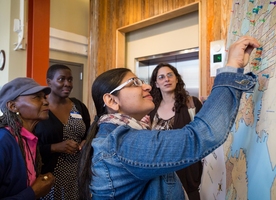
Communication, Community Participation, and Outreach

This tab provides information on how to work with frontline communities, the public and other stakeholders to understand and address climate vulnerabilities.

Resources are automatically presented by date. Apply additional filters to narrow the list by organization type of author, state, jurisdictional focus, region, or resource type. 


85 results are shown below.

Resource Type


Resource

Community School Parks Program - Los Angeles, California

2012

The Community School Parks program is a partnership service agreement and shared use policy that enables community members in under-resourced neighborhoods to access school parks and playgrounds during off-school hours when they would normally be closed to the public. People for Parks, now a program of the Los Angeles Neighborhood Land Trust (LANLT), opened the first Community School Parks in 2012 and has expanded the program since with the partnership with LANLT and the development of the shared use policy with the LA Unified School District that enables expanded access to school parks. These Community School Parks (CSPs) provide opportunities for youth, families, and neighbors within the community to connect, recreate, and enjoy green and open space in a safe environment. The program targets dense neighborhoods, typically low-income and communities of color, that are park-scarce and would not otherwise have access to open space within walking distance. In addition to Community School Parks, LANLT works to create new green space in communities of color, engaging community members from concept development through to implementation and park stewardship. 

Resource Category: Solutions


See Resource Login to Add to My Resource List


Resource

Network Rating

And the People Shall Lead: Centralizing Frontline Community Leadership in the Movement Towards a Sustainable Planet

2011

This paper summarizes a workshop held as part of the February 2011 Coal Retirement Conference that focused on how environmental organizations and frontline communities could more effectively work together. The report highlights several challenges that have stymied mutual collaboration in the past, and some core actions that can support more effective partnerships going forward. While not specific to climate adaptation, these lessons are certainly applicable to those working on equitable adaptation planning.

Resource Category: Education and Outreach


See Resource Login to Add to My Resource List


Resource

NAACP Environmental and Climate Justice Program

2010

The National Association for the Advancement of Colored People (NAACP) Environmental and Climate Justice Program was created to educate and mobilize communities to address the disproportionate impact of climate change on communities of color in the United States and around the world. NAACP explains that race - even more than class - is the number one indicator for the placement of toxic facilities in this country; while communities of color and low income communities are often the hardest hit by climate change.

Author or Affiliated User: nathaniel fobb

Resource Category: Education and Outreach


See Resource Login to Add to My Resource List


Resource

RichmondBUILD Academy - City of Richmond, California

2007

RichmondBUILD is a public-private partnership initiative launched by the City of Richmond, California to train individuals on developing the necessary talent and skill to join careers in the renewable energy or construction industries. RichmondBUILD has focused its efforts on recruiting participants from low-income households throughout the community. Since its launch in 2007, a majority of graduates of the workforce training program have been minorities (90%), and it includes a large percentage of individuals who have a history with the justice system (30%).

Resource Category: Education and Outreach


See Resource Login to Add to My Resource List


Resource

Summer Sprout Program - Cleveland, Ohio

The Summer Sprout Program in Cleveland, Ohio is a partnership between the City and Ohio State University that helps communities establish and maintain thriving neighborhood garden spaces and provides educational opportunities to develop community gardening experts.   The program was first initiated in 1976 and grew in 1977 to include a partnership with Ohio State University Extension, Cuyahoga County (OSUECC) to include educational components. The City of Cleveland Land Bank makes vacant city-owned lots available for community gardening uses and the program provides seeds, soil testing, tilling services, and other materials and services to help establish gardens and keep them running.

Resource Category: Solutions


See Resource Login to Add to My Resource List