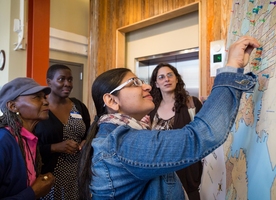
Communication, Community Participation, and Outreach
This tab provides information on how to work with frontline communities, the public and other stakeholders to understand and address climate vulnerabilities.
Resources are automatically presented by date. Apply additional filters to narrow the list by organization type of author, state, jurisdictional focus, region, or resource type.
85 results are shown below.
Filter by States AffectedSelect states to filter this list
All
Alabama Alaska American Samoa Arizona Arkansas California Colorado Connecticut Delaware District of Columbia Florida Georgia Guam Hawaii Idaho Illinois Indiana Iowa Kansas Kentucky Louisiana Maine Maryland Massachusetts Michigan Minnesota Mississippi Missouri Montana Nebraska Nevada New Hampshire New Jersey New Mexico New York North Carolina North Dakota Northern Marianas Islands Ohio Oklahoma Oregon Pennsylvania Puerto Rico Rhode Island South Carolina South Dakota Tennessee Texas Utah Vermont Virgin Islands Virginia Washington West Virginia Wisconsin Wyoming
Resource
January 1, 2014
The Prince George’s County, Maryland Clean Water Partnership (CWP) - between Prince George’s County and a private company, Corvias - began in 2014 intending to retrofit 2,000 acres of property with green infrastructure for stormwater management. As part of this process, both partners agreed that an emphasis on employing local, under-represented communities was necessary. Within the three-year period during which the project was completed, 66 businesses were contracted, almost 1,600 businesses were reached, and over 200,000 hours of work were generated.
Resource Category: Solutions
See Resource Login to Add to My Resource List
Resource
January 2014
The Clean Water Partnership (CWP) was established in 2014 between Prince George’s County, Maryland, and a private company, Corvias, to retrofit 2,000 acres to facilitate better, more resilient stormwater management. A significant component of the CWP - which has been extended 30 more years and to 4,000 more acres - is educating the community on resilient infrastructure and environmental literacy. Much of this engagement and education centers around the youth of Prince George’s County. Several programs, including the Junior Achievement Finance Park and End Time Harvest Ministries, have established training, internship, and educational programs for students throughout the school district.
Resource Category: Education and Outreach
See Resource Login to Add to My Resource List
Resource
2014
The New York City Department of Parks & Recreation (NYC Parks) Community Parks Initiative (CPI) is a program that directs investment in neighborhood parks that have the greatest needs, to create thriving public places for targeted communities. The CPI is part of a broader NYC Parks agenda – “Park Resiliency” – which ensures that parks and open spaces will withstand and recover from disruptive events such as coastal storms and catastrophic floods, and withstand more gradual threats such as sea-level-rise associated with global climate change.
Resource Category: Solutions
See Resource Login to Add to My Resource List
Resource
September 2013
Since 2012, the City of Tucson, Arizona has provided over $2 million in rebates for the Rainwater Harvesting Rebates Program, which allows the city’s water utility, Tucson Water, to subsidize the installation of rainwater catchment systems on residential properties throughout the city. The installations increase tree canopy cover, which helps to more effectively manage rainwater resources throughout the year. To increase project participation within low-income neighborhoods, the program provides grants and loans. These systems work to significantly reduce potable water use, push residents to move beyond sustainable practices and towards regenerative practices, and enhance the quality of life by extending the amount of tree canopy across Tucson.
Resource Category: Funding
See Resource Login to Add to My Resource List
Resource
September 2013
Critics of top-down, expert-driven approaches to adaptation suggest the need for tools and methods capable of addressing the gap between scientific and local understanding of climate change. After a lengthy period in which participatory mapping in the context of climate change was overlooked, attention has now turned to Participatory Three-Dimensional Modeling (P3DM) for adaptation planning. P3DM consists in a community-based process resulting in a 3D-scaled and geo-referenced relief model. Because of its relative accuracy and the possibility of being translated to Geographic Information Systems (GIS), P3DM adds credibility to locally produced content and provides a platform for multi-stakeholder dialogue.
Author or Affiliated User: Antonella Piccolella
Resource Category: Solutions
See Resource Login to Add to My Resource List
Resource
April 2013
New York City’s Learning Collaborative for Multifamily Housing Resilience demonstrates how cities can partner with community development stakeholders to conduct vulnerability assessments that enhance the resilience of low-income communities to climate disasters. In the aftermath of Hurricane Sandy in 2012, approximately 20% of the city’s public housing stock was damaged by flood waters, due in part to the placement of high concentrations of subsidized developments in surge-affected areas.
Resource Category: Planning
See Resource Login to Add to My Resource List
Resource
April 2013
This guide is a compilation of activities and resources that were developed and piloted by the Pacific Institute at community meetings, events, and workshops. These activities can be replicated by others to engage a diverse and wide-rage of people in climate adaptation planning. The guide addresses the following topics: What is Climate Change. How does climate change affect us. What can we do to prepare. How can we create more resilient communities. The activities include objectives, directions, prompts, possible modifications, an appendix of pre-designed materials, additional resources, and questions for further discussion.
Authors or Affiliated Users: Ariana de Leña, Catalina Garzón, Seth Mullendore
Resource Category: Education and Outreach
See Resource Login to Add to My Resource List
Resource
February 2013
This report presents a work plan for regional agencies to partner with community groups on climate adaptation, and support local governments in doing so as well. It also provides parallel recommendations for funders and community groups.
Author or Affiliated User: Kirsten Schwind
Resource Category: Education and Outreach
See Resource Login to Add to My Resource List
Resource
2013
The New Orleans non-profit Evacuteer. org installed clearly recognizable public art in “Evacuspots,” New Orleans’ designated emergency evacuation locations, to facilitate public transportation during a mandatory evacuation in advance of a Category three or higher hurricane. Evacuteer. org partners with the New Orleans Office of Homeland Security and Emergency Preparedness to aid in the operation of City Assisted Evacuation (CAE), the city’s free, public evacuation program to assist residents without their own means of transportation.
Resource Category: Solutions
See Resource Login to Add to My Resource List
Resource
October 2012
The Community Resilience Toolkit 2.0 is a collection of online tools to help users understand local impacts of the climate and energy crisis in their region and what they can do about them. Created by Rooted in Resilience, the tools are designed for individuals, community and nonprofit groups, classrooms, businesses, and municipal planners. The toolkit is comprised of four different documents. Each of these outline activities, and step-by-step instructions.
Author or Affiliated User: Kirsten Schwind
Resource Category: Education and Outreach
See Resource Login to Add to My Resource List