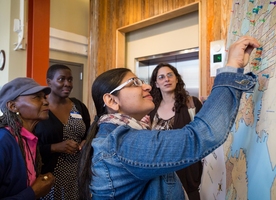
Communication, Community Participation, and Outreach
This tab provides information on how to work with frontline communities, the public and other stakeholders to understand and address climate vulnerabilities.
Resources are automatically presented by date. Apply additional filters to narrow the list by organization type of author, state, jurisdictional focus, region, or resource type.
85 results are shown below.
Filter by States AffectedSelect states to filter this list
All
Alabama Alaska American Samoa Arizona Arkansas California Colorado Connecticut Delaware District of Columbia Florida Georgia Guam Hawaii Idaho Illinois Indiana Iowa Kansas Kentucky Louisiana Maine Maryland Massachusetts Michigan Minnesota Mississippi Missouri Montana Nebraska Nevada New Hampshire New Jersey New Mexico New York North Carolina North Dakota Northern Marianas Islands Ohio Oklahoma Oregon Pennsylvania Puerto Rico Rhode Island South Carolina South Dakota Tennessee Texas Utah Vermont Virgin Islands Virginia Washington West Virginia Wisconsin Wyoming
Resource
2016
The Center for NYC Neighborhoods and the Governor's Office of Storm Recovery in New York launched an $8 million resiliency program in New York City for low- and moderate-income homeowners in 2016. To support this program, they created a free interactive website which provides NYC homeowners with personalized information on flood risks and flood insurance rates. One goal of the program is to connect low- and middle-income homeowners with engineers in select coastal communities to provide resiliency audits so they can reduce their risk to future floods and lower their insurance rates.
Resource Category: Adaptation Websites
See Resource Login to Add to My Resource List
Resource
September 5, 2015
Gulf South Rising (GSR) was a regional movement of coordinated actions and events in 2015, to highlight the impact of the global climate crisis on the U. S. Southern Gulf Coast region. This report describes the movement and introduces many of the participants. GSR was a locally-led grassroots effort that coordinated common narratives and goals from across the region, including frontline communities in Louisiana, Alabama, Texas, and Mississippi, through convenings, activism, and demonstration events.
Resource Category: Solutions
See Resource Login to Add to My Resource List
Resource
2016
In the summer of 2016, the City of Austin, MN surveyed minority, immigrant and refugee people to determine their knowledge of climate change and how it impacted them personally. Surveys were completed over a two-week period at a local non-profit called the Welcome Center, which helps new residents and immigrants transition into the city, find economic opportunities, and become part of Austin's multicultural community. Following the survey, the City compiled the results and convened a focus group with Karen women, primarily from southern and southeastern Myanmar.
Resource Category: Education and Outreach
See Resource Login to Add to My Resource List
Resource
August 2016
We the People of Detroit Community Research Collective (WPD CRC) is a collaboration among community activists, academics, researchers, and designers in Detroit, Michigan studying the impact of water insecurity, water policy, social equity, and health among local residents. The research process included (1) mapping the geographic impact of water policies on the city; (2) conducting a city-wide community survey to assess the health needs after a disaster; (3) a citizen science project to test the impact of water shutoffs on residential water quality; and (4) a story mapping project to support youth in telling individual and collective narratives about the impact of austerity on their community. The community based participatory research process has provided statistically significant data to demonstrate the impact of policy interventions on water insecurity and psychological distress among residents. WPD CRC serves as an example of how community participatory research led by community-based organizations can effectively collect qualitative data from local communities and further apply to policy development.
Resource Category: Organizations
See Resource Login to Add to My Resource List
Resource
July 2015
Resilience AmeriCorps recruits and trains AmeriCorps VISTA (Volunteers In Service To America) members to serve low-income communities across the country by developing plans and implementing projects that increase resilience-building capacity. The initiative was originally announced in 2015 in response to recommendations from President Obama’s State, Local, and Tribal Leaders Task Force on Climate Preparedness and Resilience. Current Resilience AmeriCorps projects are addressing a wide range of resilience needs, including climate change, extreme weather, financial instability, and food insecurity through long-term planning, risk communication, community loan programs, and urban food production.
Resource Category: Solutions
See Resource Login to Add to My Resource List
Resource
April, 2016
In April 2016, the Los Angeles City Council unanimously passed a groundbreaking ordinance to address environmental justice concerns within three distinct neighborhoods: Boyle Heights, Pacoima-Sun Valley, and Wilmington. For decades, these three communities – comprised primarily of low-income, Latinx individuals and families – suffered a wide range of health effects, due mostly to the high concentration of polluting industrial sites within their neighborhoods. To address these inequalities, LA City Council passed and implemented the Clean Up Green Up Ordinance with a three-pronged goal in mind: (1) to reduce pollution in the most toxic, hotspot areas; (2) to prevent additional pollution; and (3) to revitalize these neighborhoods through supporting local businesses and economic development.
Resource Category: Law and Governance
See Resource Login to Add to My Resource List
Resource
April 22, 2016
The City of Seattle, Washington released an Equity and Environment Agenda in 2016 - a plan that lays out policy goals and strategies for addressing race and social justice in environmental programs and ensuring benefits are shared by all residents equally.
Resource Category: Solutions
See Resource Login to Add to My Resource List
Resource
April 14, 2016
Supported by Oxfam America, this study documented the views of residents from three vulnerable Louisiana coastal parishes - Terrebonne, Lafourche, and Plaquemines. These parishes face extreme coastal land loss from flooding and sea level rise, and other critical climate and social impacts. The study focuses on nonstructural coastal flooding mitigation measures, such as restoring coastal marshlands. A series of interviews were conducted to investigate how residents understand and respond to the challenges of sea level rise and climate change.
Resource Category: Solutions
See Resource Login to Add to My Resource List
Resource
April 2016
This training tool, while not focused on climate change adaptation specifically, offers useful insights into community engagement at the neighborhood level. It describes what is called the “Neighborhoods First Engagement Model” (NFEM), a resident-led method of creating positive community change. This model encourages widespread participation in advocating for a better quality of life in all neighborhoods and improving communications among neighborhood groups, community development organizations, city officials, institutions and businesses.
Resource Category: Education and Outreach
See Resource Login to Add to My Resource List
Resource
March 12, 2016
Our People, Our Planet, Our Power is a compilation of. ndings, stories, and recommendations from community discussions in South Seattle/King County, Washington, facilitated by Puget Sound Sage and Got Green’s Climate Justice Project. This project was run by a steering committing of people of color, who designed and implemented a survey to identify the perspectives of people of color living in South Seattle related to climate change. Over nine months, the research team interviewed 175 people and 30 organizations to determine collective priorities and initiate a process of equitable planning.
Resource Category: Solutions
See Resource Login to Add to My Resource List